
Don’t Let One Problem Ruin Your Vacation
A few seconds now protects the trip you’ve already invested so much into.
Short Excerpt
- Aruba is one of the Caribbean’s strongest mainstream choices for travelers trying to minimize historical hurricane exposure while keeping a traditional luxury-resort vacation.
- Bonaire shares the same far-southern geographic advantage and adds a quieter, diving-focused experience with substantially lower hurricane likelihood than the northeastern Dutch Caribbean islands.
- Curaçao combines very low historical direct-impact exposure with a broader mix of resorts, beaches, dining, culture, and off-property exploration.
- The ABC islands are geographically favored rather than hurricane-proof, so nearby tropical systems can still affect rainfall, waves, flights, beaches, and resort activities.
Quick Take
- Aruba sits well south of the main Atlantic hurricane corridor, and official Aruba guidance says hurricanes are extremely rare there.
- Bonaire has a much lower likelihood of nearby hurricanes than Saba and Sint Eustatius; KNMI reports 14 hurricanes within 250 kilometers of Bonaire since 1981 in the dataset it analyzed.
- Curaçao’s meteorological record describes direct tropical cyclone landfalls as exceptionally rare, even though passing storms have occasionally caused rainfall, flooding, waves, and damage.
- All three islands sit around 12°–13°N on the southern fringe of the Atlantic hurricane region, below many of the tracks followed by tropical cyclones moving across the Caribbean.
- Peak-season travelers should still respect August through October, because 96% of Atlantic major hurricanes historically occur during those three months.
- The best ABC island depends less on a tiny difference in hurricane exposure than on whether you want Aruba’s resort convenience, Bonaire’s diving, or Curaçao’s combination of resorts and island exploration.
Aruba, Bonaire, and Curaçao Have A Real Geographic Advantage
If your first priority is finding Caribbean islands that historically experience fewer hurricanes, the ABC islands deserve to be at the top of the conversation.
Aruba, Bonaire, and Curaçao sit in the southern Caribbean, close to the northern coast of South America.
Their location around 12°–13° north latitude places them on the southern fringe of the Atlantic hurricane region rather than directly inside many of the heavily traveled storm corridors farther north.
That geographic difference has practical consequences.
A hurricane moving west across the tropical Atlantic frequently reaches the latitude of the Lesser Antilles, Puerto Rico, Hispaniola, or the Bahamas before steering patterns change its direction.
Many systems pass north of the ABC islands rather than directly across them.
Local climate conditions provide another advantage.
The Meteorological Department Curaçao notes that colder coastal upwelling near Venezuela, atmospheric subsidence, and the influence of the nearby South American mainland can suppress cloud and storm development around the Dutch Leeward islands.
None of those factors creates an invisible wall around Aruba, Bonaire, or Curaçao.
Tropical cyclones can pass nearby. Heavy rainfall can occur.
Coastal flooding is possible. Beaches, diving, boating, flights, and resort operations can be disrupted even when a hurricane center never crosses an island.
The meaningful conclusion is therefore lower historical exposure, not guaranteed safety.
That distinction becomes especially important during August, September, and October.
The Atlantic hurricane season officially runs from June 1 through November 30, with the climatological peak around September 10 and most activity concentrated between mid-August and mid-October.
Choosing an ABC island does not erase that seasonal pattern.
What it does is give you one of the Caribbean’s strongest geographic advantages while the rest of the basin is entering its most active period.
ABC Islands Hurricane Risk Comparison
Comparing Aruba, Bonaire, and Curaçao with a simple numerical score would create more precision than the historical records support.
Different official sources use different time periods, radii around each island, and definitions of a nearby tropical cyclone.
Aruba’s tourism authority highlights its direct-hit history, KNMI reports hurricanes within 250 kilometers of Bonaire, while Curaçao’s meteorological service maintains a much longer local cyclone record using another distance threshold.
For that reason, the most useful comparison is qualitative.
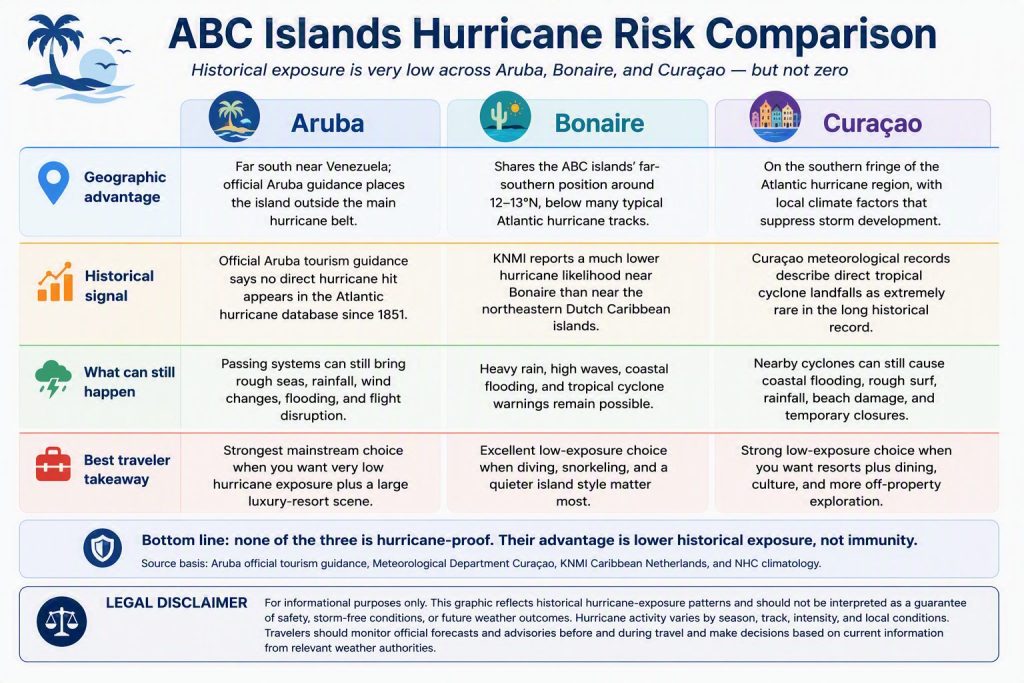
| Factor | Aruba | Bonaire | Curaçao |
|---|---|---|---|
| Relative historical exposure | Very low | Very low | Very low |
| Geographic position | Far-southern Caribbean near Venezuela | Far-southern Caribbean near Venezuela | Far-southern Caribbean near Venezuela |
| Official historical signal | Aruba guidance says no direct hurricane hit appears in the Atlantic database since 1851 | KNMI reports substantially lower nearby-hurricane likelihood than the northeastern Dutch Caribbean | Local climatology describes direct landfalls as exceptionally rare |
| Indirect effects possible? | Yes | Yes | Yes |
| Strongest travel fit | Large luxury-resort selection and easy vacation planning | Diving, snorkeling, smaller properties, quieter experience | Resorts, dining, beaches, culture, and exploration |
The table should not be read as saying the three islands have mathematically identical risk.
Instead, it shows why trying to rank them 1, 2, and 3 by a fabricated hurricane-risk percentage would be misleading.
Their shared southern location is the bigger story.
Aruba: The Most Familiar Low-Hurricane-Risk Choice
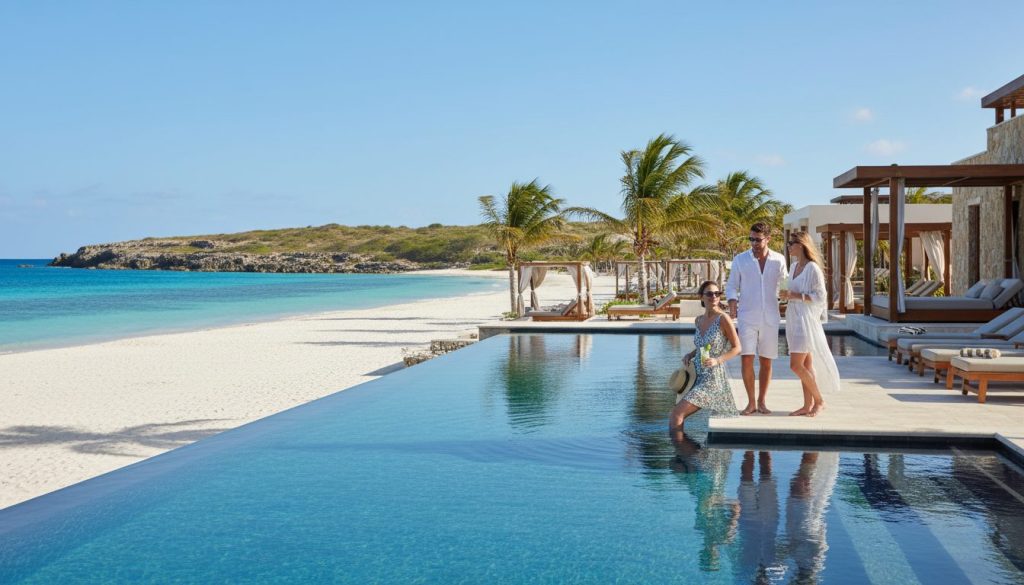
Aruba usually receives the most attention when travelers search for Caribbean islands least affected by hurricanes.
Official Aruba guidance describes the island as outside the main hurricane belt and says hurricanes are extremely rare because of its far-southern location.
Aruba lies roughly 15 to 18 miles north of Venezuela, which places it considerably farther south than many major Caribbean resort destinations.
A more recent Aruba tourism explanation goes further.
It states that the Atlantic hurricane database has no direct hurricane hit on Aruba since the database begins in 1851.
That is an unusually strong historical record for a Caribbean resort island.
Does Aruba Really Avoid Hurricanes?
Historically, direct hurricane impacts have been exceptionally uncommon.
That does not mean a tropical cyclone cannot affect Aruba.
Hurricane Ivan passed north of the island in 2004 and produced high waves, inland flooding, and coastline changes.
Hurricane Felix passed relatively close in 2007, bringing rough seas and strong winds without making a devastating direct strike.
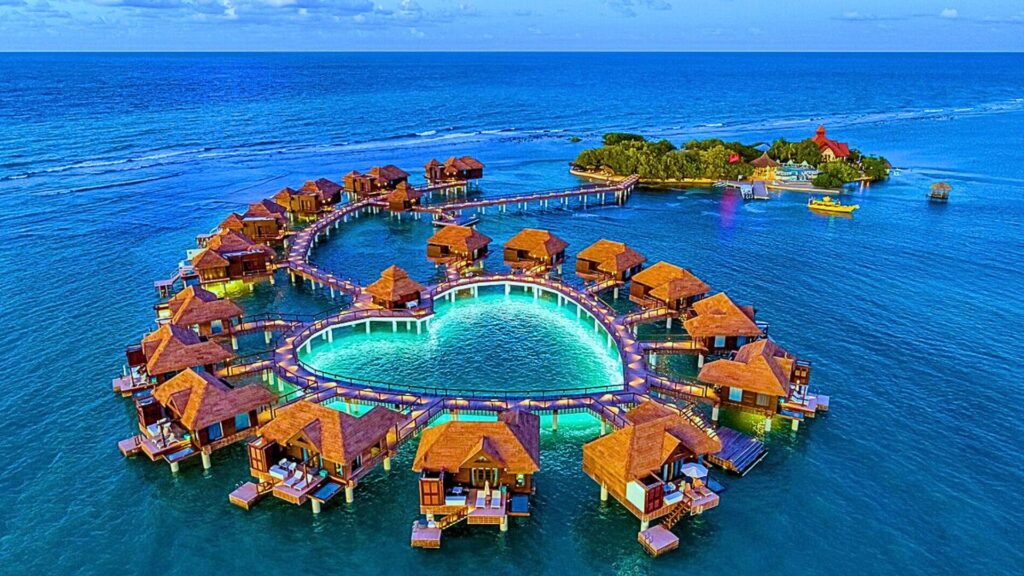
Paradise Is Calling Your Name
Explore Sandals & Beaches deals
Those examples illustrate the distinction that matters most for travelers.
Aruba can avoid the hurricane center and still experience the hurricane’s influence.
A luxury resort may remain open while water activities are canceled. Beach conditions can change.
Boat excursions may stop operating. Flights could be delayed because of weather elsewhere in the region.
The island’s geography substantially reduces one risk without eliminating every possible disruption.
Is Aruba A Good Choice In September?
For travelers committed to a September Caribbean vacation, Aruba is one of the strongest destinations to consider.
September sits near the climatological peak of the Atlantic season, so choosing a location well south of common storm tracks can be particularly valuable.
Aruba’s lower exposure does not make September equivalent to January, but it changes the comparison with more exposed destinations.
Someone choosing between Aruba and the Virgin Islands primarily on hurricane risk would have a compelling reason to favor Aruba during this period.
Resort selection strengthens that case.
Aruba has a substantial inventory of upscale beachfront hotels, restaurants, casinos, shopping, spas, pools, and familiar vacation infrastructure.
You do not have to accept a remote or highly specialized destination simply to gain the geographic benefit.
What About Aruba In October?
October remains part of the active Atlantic hurricane season, even after the September climatological peak.
Aruba’s geographic advantage continues to matter, but the island can also enter a somewhat wetter period.
Official Aruba climate guidance identifies October through December as its rainy season, although rainfall patterns there differ from the wetter tropical environments farther north.
Travelers should therefore separate two questions.
How likely is a direct hurricane? Historically, very unlikely.
Can I encounter showers, clouds, rough water, or weather-related changes? Yes.
That distinction prevents a common disappointment: choosing Aruba because hurricanes are rare and then assuming the forecast must be cloudless every day.
Who Should Choose Aruba?
Aruba makes the strongest case for travelers who want lower hurricane exposure without changing the basic structure of a luxury Caribbean vacation.
Couples can choose from large beachfront resorts and adults-oriented properties.
Families have extensive resort infrastructure and easy beach access.
First-time Caribbean travelers often appreciate how straightforward the island feels.
Anyone who values restaurants, nightlife, shopping, and resort amenities alongside the weather advantage may find Aruba easiest to justify.
A traveler seeking solitude, world-class shore diving, or a more exploration-heavy itinerary may prefer one of its ABC neighbors.
Bonaire: Lower Hurricane Exposure With A Quieter Personality
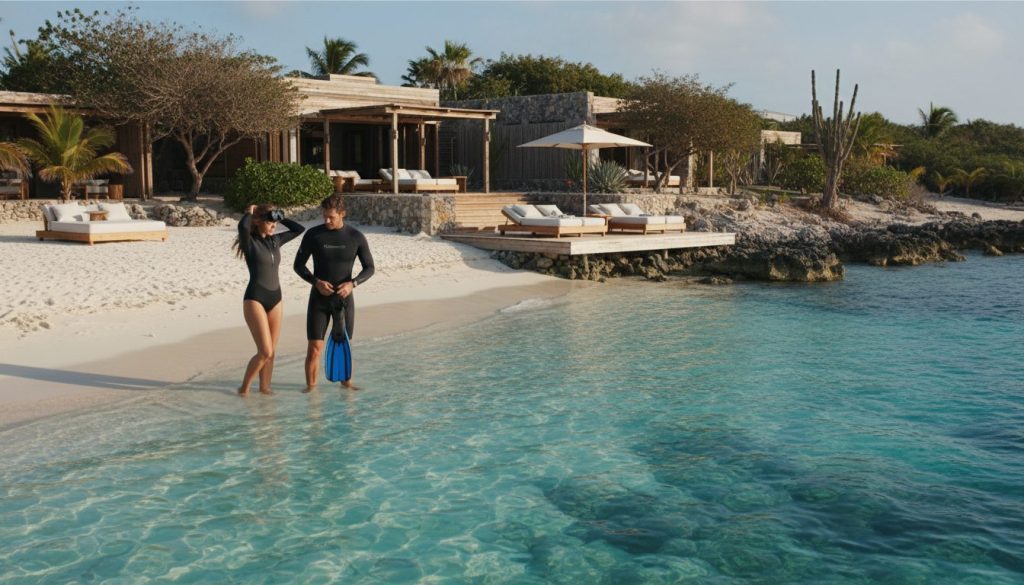
Bonaire receives less mainstream attention than Aruba, yet its hurricane geography is equally important.
The island occupies the same southern Caribbean zone around 12° north latitude.
KNMI climate analysis describes Bonaire as having a much lower likelihood of nearby hurricanes than Saba and Sint Eustatius in the northeastern Dutch Caribbean.
One KNMI summary reports 14 hurricanes within 250 kilometers of Bonaire since 1981, substantially fewer than the comparable figure for the northeastern islands in that analysis.
That does not make the number directly comparable with Aruba’s no-direct-hit statement.
A hurricane passing within 250 kilometers is not the same event as a hurricane making landfall. Different measurement methods answer different questions.
The useful takeaway remains straightforward: Bonaire has an unusually favorable hurricane profile for a Caribbean island.
Why Is Bonaire Less Frequently Hit?
Latitude plays the largest role.
Many Atlantic tropical cyclones travel west at latitudes north of Bonaire or begin curving toward the northwest before approaching its location.
Environmental conditions around the southern Dutch Caribbean also work against storm development nearby.
The regional climatology describes cooler coastal upwelling, drier atmospheric influences, and subsiding air around the Venezuelan coast as factors that can suppress convection.
Escape the Chaos. Upgrade to Paradise.
See today’s exclusive offers
Those conditions do not weaken every cyclone approaching from elsewhere.
A strong hurricane passing north of Bonaire can remain powerful while the island experiences indirect effects.
Natural protection, therefore, is better understood as reduced exposure created by location and climatology, not as a physical shield.
Can Bonaire Still Get Tropical Storm Warnings?
Yes.
The ABC islands received tropical storm warnings during Tropical Storm Bonnie in 2022, demonstrating that even these low-exposure destinations still require tropical-weather preparedness.
The system brought significant rainfall, coastal flooding, and beach damage in parts of the region.
KNMI maintains tropical cyclone bulletins and warning procedures for Bonaire in coordination with the National Hurricane Center.
That official infrastructure is important.
Lower risk should never be interpreted as a reason to ignore warnings.
Is Bonaire Good In September Or October?
Bonaire is one of the Caribbean destinations worth serious consideration during both months when hurricane avoidance is a priority.
September remains the climatological peak across the Atlantic basin, but Bonaire’s southern location lowers its historical exposure relative to many islands farther north.
October can bring more rainfall as the regional wet season develops.
Marine conditions can also be influenced by distant systems even when the island never enters a hurricane warning area.
Divers need to think beyond wind speed.
A tropical system can change visibility, currents, wave conditions, boat schedules, or shore access.
If diving is the main purpose of the trip, temporary marine disruptions may matter more to you than whether a storm technically makes landfall.
Bonaire’s Coastal Vulnerability Still Matters
Low hurricane frequency should not be confused with immunity from coastal hazards.
Government planning documents identify low-lying parts of Bonaire, including sections around Kralendijk and the island’s south, as vulnerable to flooding from the sea under certain storm conditions.
That issue illustrates why hurricane categories alone do not describe all travel risk.
Water can create problems even without a direct Category 1, 2, or 3 landfall.
For a visitor, the practical concern may be a flooded road, canceled dive, damaged shoreline, or rough water rather than destructive winds at the hotel.
Who Should Choose Bonaire?
Bonaire works best for travelers who see the ocean as the main attraction rather than simply the view from a resort balcony.
Divers and snorkelers have the strongest reason to choose it.
Couples seeking a quieter island can also appreciate the smaller-scale atmosphere.
Repeat Caribbean visitors may find Bonaire refreshingly different from the heavily developed resort corridors elsewhere in the region.
Someone expecting extensive nightlife, a huge all-inclusive scene, or dozens of large beachfront resorts may prefer Aruba or Curaçao.
The hurricane advantage is real across all three ABC islands, so vacation style should carry substantial weight once Bonaire reaches your shortlist.
Curaçao: Low Hurricane Exposure with the Most Variety Beyond the Resort
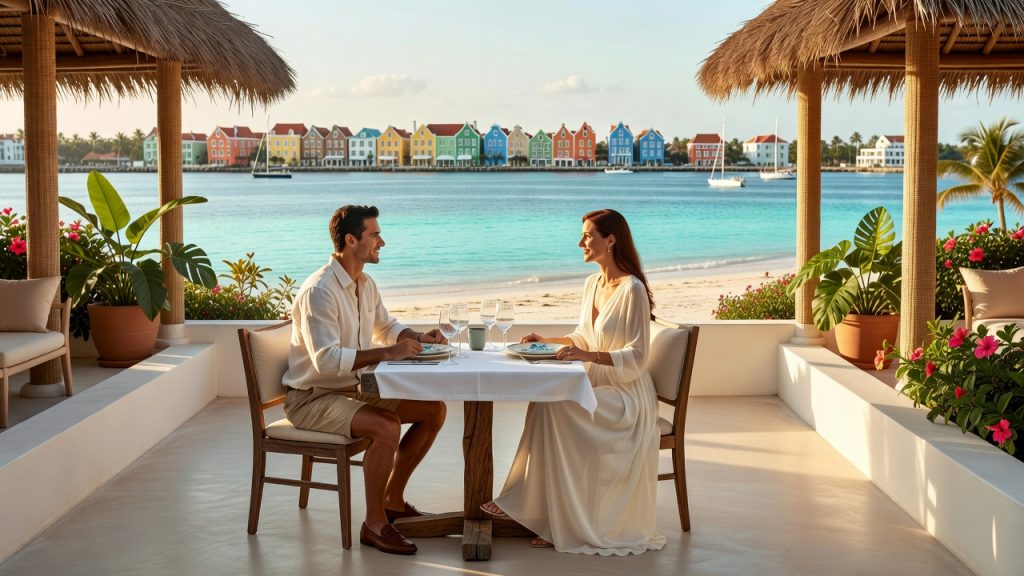
Curaçao combines the ABC islands’ favorable geography with a broader travel experience than many visitors expect from a lower-risk hurricane-season destination.
The Meteorological Department Curaçao places Aruba, Bonaire, and Curaçao on the southern edge of the Atlantic hurricane region.
Its current climatology describes direct impacts as relatively rare compared with islands farther north.
Curaçao also has one of the most detailed local historical records of the three islands.
The department reports more than 37 tropical cyclones passing within 100 nautical miles of Curaçao from 1605 through 2024, while describing direct tropical storm or hurricane landfalls as absent from that long record.
That sounds almost impossibly reassuring until you look at the details.
Nearby storms have still caused serious effects.
Curaçao Has Experienced Hurricane Damage Without A Direct Landfall
A hurricane passed just south of Curaçao in September 1877 and caused substantial damage around Willemstad.
Historical accounts include coastal destruction, lost ships, and fatalities.
Much more recently, Hurricane Matthew passed north of Curaçao in 2016.
Tropical Storm Bonnie affected the ABC islands in 2022 with warnings, heavy rain, coastal flooding, and beach damage.
Hurricane Beryl crossed much farther north in 2024 and produced comparatively limited effects on the ABC islands.
Together, those examples reinforce the right way to interpret Curaçao’s history.
A direct strike is exceptionally unusual.
Meaningful effects from nearby tropical systems are possible.
Is Curaçao Outside The Hurricane Belt?
This question needs a more nuanced answer than many travel pages provide.
The older detailed hurricane climatology published by the Meteorological Department Curaçao describes the ABC islands as being on the southern fringes of the hurricane belt, explicitly cautioning that they should not simply be treated as entirely outside it.
Current regional material similarly describes the Dutch Leewards as sitting on the southern edge of the Atlantic hurricane region.
Find the Escape You’ve Been Craving.
Reveal limited‑time Caribbean deals
That phrasing is more useful than arguing over whether a tourism map draws the border one way or another.
Curaçao is clearly less exposed than many Caribbean islands.
It is not meteorologically untouchable.
How Rare Are Nearby Storms?
Current Curaçao climatology estimates that a tropical cyclone passes within 100 nautical miles of the island roughly once every 11 years on average.
An older study used a different radius and methodology, so its recurrence figure is different.
That is another reason not to reduce hurricane risk to a single number without explaining the underlying measurement.
For travelers, the long-term pattern is more useful than arguing over the precise recurrence interval.
Most Curaçao vacations will not involve a tropical cyclone nearby.
Peak season still deserves monitoring because rare is not the same as impossible.
Is Curaçao Good In September?
Yes, particularly for travelers who want lower hurricane exposure while still having plenty to do away from the resort.
September is statistically an active Atlantic month.
Curaçao’s southern latitude changes its historical exposure, but the overall basin can still be busy.
A practical September plan should therefore combine the island’s geographic advantage with flexible bookings.
Check the resort’s hurricane policy.
Understand the airline’s change rules.
Monitor official forecasts closer to departure.
Then enjoy the destination without treating every tropical wave thousands of miles away as an immediate threat.
What Makes Curaçao Different From Aruba?
Travel style is the biggest distinction.
Aruba makes resort vacationing extremely easy.
Curaçao offers more reasons to leave the resort.
Willemstad adds architecture, dining, shopping, and history.
Smaller beaches and coves create a different coastline experience.
Snorkeling and diving remain strong, while upscale resorts give travelers plenty of options for mixing property time with island exploration.
A couple planning seven nights may therefore see Curaçao as the better value if they want variety.
Someone primarily interested in a polished resort, a broad beach, and simple logistics may still favor Aruba.
Which Of The Three ABC Islands Is Least Affected By Hurricanes?
There is no responsible reason to manufacture a precise winner from incompatible historical datasets.
Aruba has perhaps the strongest easy-to-understand consumer statistic: its official tourism authority says no direct hurricane hit appears in the Atlantic database since 1851.
Bonaire has strong modern climate evidence showing substantially lower nearby-hurricane likelihood than the northeastern Dutch Caribbean.
Curaçao has an unusually long local historical record documenting many nearby systems but exceptionally rare direct landfalls.
Turn Your Next Getaway into Magic.
Discover your perfect resort match
Those findings all point in the same direction.
The ABC islands as a group are among the strongest Caribbean choices for reducing historical hurricane exposure.
Trying to claim that one has 12% less risk than another would give readers a false sense of precision.
A better comparison asks what happens after hurricane exposure is low enough for all three to make your shortlist.
Aruba Vs. Bonaire Vs. Curaçao For Luxury Travelers
| If You Prioritize… | Best Starting Point | Why |
|---|---|---|
| Large luxury-resort selection | Aruba | Extensive beachfront infrastructure and easy resort-centered travel |
| Diving and snorkeling | Bonaire | Water activities are central to the island experience |
| Restaurants and culture | Curaçao | Willemstad and off-property exploration add variety |
| First ABC islands trip | Aruba | Easiest transition for travelers accustomed to major Caribbean resorts |
| Quieter couples trip | Bonaire | Smaller-scale atmosphere and less emphasis on nightlife |
| Resort plus exploration | Curaçao | Strong balance of hotel options, beaches, dining, and sightseeing |
| Hurricane-risk reduction | All three | Their shared southern geography is more important than forcing a tiny ranking difference |
That last row is the most important.
Choose Aruba, Bonaire, or Curaçao because all three offer a favorable hurricane-risk starting point.
Then let the vacation you actually want determine the winner.
Why The ABC Islands Have Fewer Hurricane Encounters
Their latitude is only part of the explanation.
They Sit Far South
Tropical cyclones commonly form farther east and travel west or west-northwest across the Atlantic.
NHC climatology notes that tropical cyclones forming between roughly 5° and 30° north latitude usually begin by moving west before changes in atmospheric steering can turn them north or northwest.
The ABC islands occupy the low end of that latitude range.
Many systems consequently pass north of them.
Nearby Waters Can Be Less Favorable For Development
Coastal upwelling along Venezuela brings cooler subsurface water toward the surface.
According to Curaçao’s meteorological climatology, those cooler waters can suppress cloud development in the region.
A nearby developing disturbance therefore does not always encounter the same environmental setup found farther north or east.
Atmospheric Subsidence Can Suppress Convection
Regional ocean-land interactions also promote descending air around the islands.
Descending air makes deep thunderstorm development more difficult, which can work against local tropical cyclone formation.
Again, none of this guarantees protection from a powerful system arriving from elsewhere.
The conditions simply help explain why the historical record looks different from much of the Caribbean.
Are The ABC Islands Naturally Protected?
Geographically favored is the more accurate phrase.
No mountain range, reef, wind pattern, or ocean current guarantees that a hurricane cannot reach Aruba, Bonaire, or Curaçao.
Their advantage comes from several probabilities lining up in their favor:
- a far-southern latitude
- typical Atlantic storm tracks passing farther north
- regional atmospheric subsidence
- cooler coastal upwelling near Venezuela
- a drier southern Caribbean climate
Together, those factors help reduce exposure.
A changing climate also argues against treating history as a promise about the future.
KNMI climate scenarios for the Dutch Caribbean indicate that hurricane hazards and extreme rainfall still deserve long-term attention even where historical hurricane frequency has been comparatively low.
That is particularly relevant for low-lying coastal areas.
The safest language remains least affected historically, not permanently protected.
What Happens If A Hurricane Passes North Of The ABC Islands?
A near miss can still change your trip.
Ocean conditions often respond before resort guests experience notable wind.
Dive boats can remain at the dock.
Snorkeling excursions may be postponed.
Beach conditions can deteriorate.
Rain bands might produce temporary flooding.
Airlines can alter schedules if aircraft or crews are coming through a weather-affected hub.
Resort management may secure outdoor furniture or adjust events as a precaution.
None of those outcomes requires hurricane-force winds at your hotel.
This is why travelers should ask two separate questions:
What is the risk of a direct hurricane impact?
What is the risk that tropical weather somewhere nearby disrupts part of my vacation?
The ABC islands perform extremely well on the first question.
No island can completely eliminate the second.
Which Months Give You The Best Hurricane-Season Advantage?
June
June begins the official Atlantic hurricane season, but average activity is still relatively low.
NHC climatology places the typical first named storm around June 20.
Travelers choosing an ABC island in June therefore combine a generally quieter point in the Atlantic season with one of the basin’s lower-exposure regions.
That combination can be appealing for travelers looking for summer pricing without heading directly into the climatological peak.
July
July brings gradually increasing tropical activity.
Long-track Atlantic hurricanes are not yet as climatologically dominant as they become later, although storms can still form and affect the Caribbean.
ABC island geography continues to provide an advantage.
Someone flexible about travel dates may view July as a useful middle ground between early-summer pricing and lower storm activity.
August
The risk calculation changes more noticeably during August.
NHC records show that the first hurricane of an average season tends to form in early to mid-August, while the first major hurricane typically arrives in late August or early September.
Choosing Aruba, Bonaire, or Curaçao becomes more valuable from a risk-reduction perspective as basin-wide activity rises.
Monitoring should also become more deliberate.
September
September is the strongest test of the low-exposure strategy.
The Atlantic climatological peak occurs around September 10.
If you want a Caribbean trip during this month and hurricane exposure weighs heavily in your decision, the ABC islands are difficult to overlook.
Their geography does not make the Atlantic inactive.
It gives you a destination located away from many of the tracks responsible for the higher historical exposure farther north.
October
October remains meaningful.
NHC’s mariner climatology reports that 96% of Atlantic major hurricanes occur between August and October.
The ABC islands remain attractive, but rainfall can also become more noticeable during the southern Caribbean wet season.
Do not confuse lower hurricane risk with guaranteed dry weather.
November
The official season continues through November 30, while basin-wide activity generally declines as the month progresses.
Travelers who prefer the ABC islands but dislike peak-season uncertainty may find November more appealing than September.
Late-season tropical systems remain possible, so official forecasts still deserve attention.
Are Aruba, Bonaire, And Curaçao Safer Than Barbados or St. Lucia?

From the narrow standpoint of historical direct hurricane exposure, the ABC islands generally offer a more favorable profile.
Barbados and St. Lucia sit farther north and east and have experienced more direct interaction with tropical cyclones.
That does not automatically make the ABC islands better vacation destinations.
A honeymoon couple may strongly prefer St. Lucia’s mountain scenery and private-pool resorts.
Another traveler may value Barbados for its dining, beaches, and particular hotel choices.
The tradeoff is straightforward.
Choosing the ABC islands can reduce hurricane exposure.
Choosing another destination may deliver an experience you prefer enough to justify accepting more weather uncertainty.
Does Lower Hurricane Risk Mean Better Weather?
Not necessarily.
Hurricane frequency is only one part of climate.
The ABC islands can have rain, cloud cover, high humidity, strong trade winds, rough seas, or localized flooding without a hurricane anywhere nearby.
Their landscapes also look different from the lush tropical imagery associated with islands such as St. Lucia or Dominica.
Aruba is notably dry and arid.
Bonaire has a similarly dry southern Caribbean character.
Curaçao mixes dry terrain with greener resort landscaping and colorful urban scenery.
Travelers who equate “tropical” with dense rainforest should understand that the same regional climate helping create a drier environment also shapes what these islands look like.
That may be a positive.
It may also change which island feels most romantic or visually appealing to you.
Should You Still Buy Travel Insurance For An ABC Islands Trip?
For an expensive nonrefundable trip, it can still make sense.
The reason is broader than direct hurricane landfall.
A policy may provide eligible protection for trip cancellation, interruption, delay, missed connections, or other covered events depending on its terms.
VisitorsCoverage and Insubuy can be useful for comparing options, while EKTA may also be worth evaluating depending on the trip.
Read the actual policy wording.
Weather coverage varies.
Purchase timing can matter after a storm becomes a known event.
A $15,000 honeymoon or villa stay creates a very different financial exposure from a refundable three-night hotel reservation.
Insurance should match the money at risk rather than the emotional reassurance of simply having a policy.
What Should You Ask The Resort Before Booking?
A low-risk island does not make resort terms irrelevant.
Ask what happens if a tropical storm warning is issued.
Find out whether airport closure triggers a refund or only a future credit.
Check how the property handles guests who cannot arrive because flights are canceled.
Determine whether unused nights are refundable if a guest has to leave early.
Review any hurricane guarantee carefully.
Large luxury resorts may also have generators, emergency supplies, protected common areas, backup communications, and established storm procedures.
Those measures can make a disruption easier to manage.
They do not change the island’s meteorology.
Which ABC Island Should You Book?
Use hurricane risk to get all three islands onto the shortlist.
Then choose based on your trip.
Choose Aruba If…
You want the broadest traditional luxury-resort experience.
Beachfront hotels, restaurants, nightlife, casinos, pools, spas, and easy vacation logistics carry more weight than diving or cultural exploration.
Choose Bonaire If…
Being in the water is central to your trip.
Diving, snorkeling, a smaller property, and a quieter island atmosphere matter more than a large resort corridor.
Choose Curaçao If…
You want a balance.
Resort time still matters, but so do restaurants, architecture, beaches, snorkeling coves, Willemstad, and days spent exploring away from the property.
There is no need to force the hurricane data to choose for you.
All three begin with an unusually favorable historical position.
Practical Takeaways For Choosing The Least Hurricane-Affected Caribbean Islands
- Start with Aruba, Bonaire, and Curaçao when minimizing historical hurricane exposure is a primary booking goal.
- Treat the ABC islands as geographically favored rather than hurricane-proof, because nearby storms can still affect rain, surf, flights, and activities.
- Use Aruba as the easiest luxury-resort choice when you want extensive infrastructure and straightforward vacation planning.
- Consider Bonaire first when diving, snorkeling, and a quieter island experience are more important than nightlife or large resorts.
- Choose Curaçao when lower hurricane exposure needs to coexist with dining, culture, beaches, and significant off-property exploration.
- Give August through October more attention than June or July because Atlantic major-hurricane activity is heavily concentrated in that period.
- Separate direct-hit risk from trip-disruption risk when evaluating how much flexibility you need.
- Check resort cancellation terms even on lower-risk islands, especially when a large portion of the trip is nonrefundable.
- Use official National Hurricane Center and local meteorological information when a tropical system develops.
- Let the type of vacation break the tie once all three ABC islands satisfy your weather-risk tolerance.
Aruba, Bonaire, and Curaçao are not compelling hurricane-season choices because nothing can ever happen there.
They are compelling because the historical record, geography, and regional climate all point toward significantly lower tropical cyclone exposure than travelers face in many other Caribbean destinations.
That advantage becomes particularly meaningful when the Atlantic reaches its August-through-October peak.
For travelers who still want a luxury Caribbean vacation during those months, the ABC islands offer something rare: a way to reduce weather exposure without giving up the Caribbean altogether.
FAQ – Which Caribbean Islands Are Least Affected by Hurricanes?
Which Caribbean Islands Are Least Affected by Hurricanes?
Aruba, Bonaire, and Curaçao are among the strongest Caribbean choices for travelers trying to minimize historical hurricane exposure.
Their far-southern location places them below many typical Atlantic hurricane tracks, while regional climate conditions also work against tropical cyclone development nearby.
Direct impacts remain unusually rare compared with many islands farther north.
None of the ABC islands should be treated as completely immune to tropical weather.Is Aruba the Caribbean Island Least Likely to Be Hit by a Hurricane?
Aruba has one of the easiest low-risk records for travelers to understand because official Aruba guidance says no direct hurricane hit appears in the Atlantic hurricane database since 1851.
Its location near Venezuela keeps it well south of the region’s most frequently traveled hurricane corridors.
Nearby storms have still produced waves, flooding, rain, and other indirect effects.
The historical record therefore supports calling Aruba very low exposure rather than hurricane-proof.How Often Do Hurricanes Affect Bonaire?
Hurricanes near Bonaire are relatively uncommon compared with the northeastern Dutch Caribbean.
KNMI reports 14 hurricanes within 250 kilometers of Bonaire since 1981 in one climate analysis and describes hurricane likelihood there as much lower than around Saba and Sint Eustatius.
A storm does not need to make landfall to affect diving, waves, rainfall, or coastal conditions.
Travelers should still follow tropical cyclone warnings when they are issued.Has Curaçao Ever Been Hit by A Hurricane?
Direct tropical cyclone landfalls are exceptionally rare in Curaçao’s long local climatological record.
Nearby hurricanes have nevertheless caused serious impacts, including the destructive 1877 storm that passed just south of the island.
More recent systems such as Matthew, Bonnie, and Beryl demonstrate that Curaçao can experience indirect effects while the cyclone center stays elsewhere.
Historical rarity therefore reduces risk without eliminating it.Why Are Aruba, Bonaire, And Curaçao Less Affected by Hurricanes?
Their geography provides the main advantage.
The ABC islands sit around 12°–13° north latitude near Venezuela, below many typical Atlantic hurricane tracks.
Regional climatology also identifies cooler coastal upwelling and atmospheric subsidence as factors that can suppress storm development nearby.
Those conditions make hurricane encounters less frequent, but they cannot stop a powerful cyclone from passing through the region.Are The ABC Islands Safe to Visit in September?
They are among the Caribbean’s strongest September choices when reducing hurricane exposure is a priority.
September remains the climatological peak of the Atlantic hurricane season, so tropical activity elsewhere in the basin can still affect flights, waves, or weather.
Choosing an ABC island changes the geographic exposure rather than removing the season itself.
Flexible reservations and official forecast monitoring still make sense.Is October a Good Month for Aruba, Bonaire, Or Curaçao?
October can still be a good time to visit, especially for travelers who value the ABC islands’ lower hurricane exposure.
Atlantic major hurricanes remain climatologically relevant during October, and the southern Caribbean wet season can also bring more showers.
Travelers should therefore distinguish hurricane risk from ordinary rainfall.
A trip can avoid a tropical cyclone and still include changeable weather.Which ABC Island Is Best for a Luxury Vacation?
Aruba is usually the easiest choice for travelers who want a large traditional luxury-resort scene.
Curaçao works particularly well when restaurants, culture, beaches, and off-property exploration are important alongside resort time.
Bonaire has the strongest appeal for diving, snorkeling, and a quieter island experience.
Hurricane risk is low enough across all three that vacation style can reasonably become the deciding factor.Can A Hurricane Disrupt an ABC Islands Vacation Without Hitting the Island?
Yes.
Distant storms can create rough surf, canceled boat trips, rainfall, flight changes, coastal flooding, or temporary resort adjustments without producing a direct hurricane landfall.
Connecting airports can also be affected even when conditions on Aruba, Bonaire, or Curaçao remain manageable.
Direct-hit risk and trip-disruption risk should therefore be evaluated separately. Flexible bookings help address the second problem.Do I Still Need Travel Insurance for Aruba, Bonaire, Or Curaçao During Hurricane Season?
It can be worthwhile when a substantial amount of the trip is prepaid and nonrefundable.
Insurance may cover eligible cancellations, interruptions, delays, or missed connections depending on the policy and covered reason.
Lower hurricane exposure does not protect you from airline problems or indirect weather disruptions elsewhere in the travel network.
Policy terms and purchase timing matter more than simply choosing a plan labeled for hurricane-season travel.