
Don’t Let One Problem Ruin Your Vacation
A few seconds now protects the trip you’ve already invested so much into.
Short Excerpt
- Aruba, Bonaire, and Curaçao are the Caribbean’s strongest mainstream choices when minimizing historical hurricane exposure is the priority.
- Trinidad and Tobago also sit far south, while Barbados, Grenada, and St. Lucia can offer a more favorable storm profile than many northern islands without matching the ABC islands’ lower exposure.
- “Storm-free” should be read as traveler shorthand for lower historical hurricane exposure, not as a promise that a destination will avoid rain, rough seas, flight delays, or indirect storm effects.
- Peak-season timing still matters, so even lower-exposure islands deserve closer weather monitoring, flexible booking terms, and a practical backup plan from August through October.
Quick Take
- Start with Aruba or Curaçao if you want the easiest combination of lower hurricane exposure, luxury resort options, and straightforward vacation planning.
- Bonaire is especially appealing when diving, snorkeling, and a quieter island feel matter more than a large-resort scene.
- Trinidad and Tobago deserve attention for their southern location, although the vacation experience differs from the classic resort model many travelers expect.
- Barbados, Grenada, and St. Lucia can be sensible alternatives for travelers willing to accept more exposure in exchange for a destination they prefer.
- Direct hurricane risk and trip-disruption risk are different, because a distant system can affect flights, surf, excursions, or connecting airports without hitting your island.
- Smart planning pairs geography with refundable reservations, strong resort policies, appropriate travel protection, and official forecasts as departure approaches.
“Storm-Free” Is A Useful Shortcut, But It Needs A Precise Meaning
Travelers searching for a storm-free Caribbean destination usually are not asking for a meteorological guarantee.
Most are trying to find an island where the historical odds of a direct hurricane impact are meaningfully lower, especially during August, September, or October.
That distinction is important because no Caribbean destination can promise perfect conditions through the entire Atlantic hurricane season.
A tropical cyclone hundreds of miles away can still create high surf, unusual rainfall, wind shifts, flight changes, ferry interruptions, or canceled excursions.
Geography nevertheless changes the odds in a useful way.
Islands along the far southern edge of the Caribbean sit outside many of the classic tracks followed by long-distance Atlantic hurricanes, while destinations farther north and northeast lie closer to routes used more often during the heart of the season.
For a luxury traveler, the practical question is therefore not “Where can nothing happen?” A better question is “Where can I reduce historical hurricane exposure without giving up the kind of vacation I actually want?”
That framing produces a much more useful shortlist. It also prevents travelers from confusing lower risk with zero risk, which can lead to overly rigid bookings or unrealistic expectations.
Why The Southern Caribbean Usually Wins the Risk-Avoidance Conversation
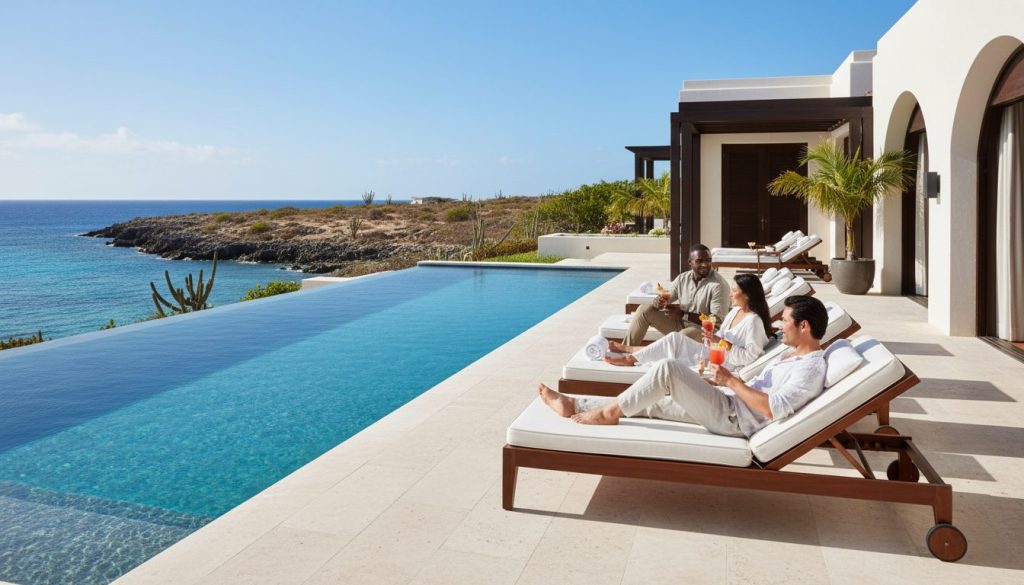
An upscale ABC islands resort welcomes beautiful travelers beside turquoise water and a dry southern Caribbean landscape
The Caribbean stretches across a much wider area than it appears to on a small resort map.
A few hundred miles of latitude can materially change historical exposure to tropical cyclones.
Near the coast of South America, Aruba, Bonaire, and Curaçao sit along the southern fringe of the Atlantic hurricane region.
Trinidad and Tobago lie even farther south, which is why those destinations repeatedly appear in hurricane-season risk discussions.
Farther north, the picture changes.
Puerto Rico, the Virgin Islands, the northern Lesser Antilles, the Bahamas, and other destinations sit closer to long-established storm corridors that become especially important when the tropical Atlantic is most active.
Seasonal timing adds another layer.
June and July generally carry less basin-wide activity than the core period from mid-August through mid-October, while late-season development can shift attention toward the western Caribbean.
Taken together, geography and timing explain why two islands can share the same official hurricane season while offering very different historical risk profiles.
Resort quality, flight access, price, and trip flexibility then determine whether that geographic advantage actually makes one destination better for you.
Storm-Free Caribbean Destination Map
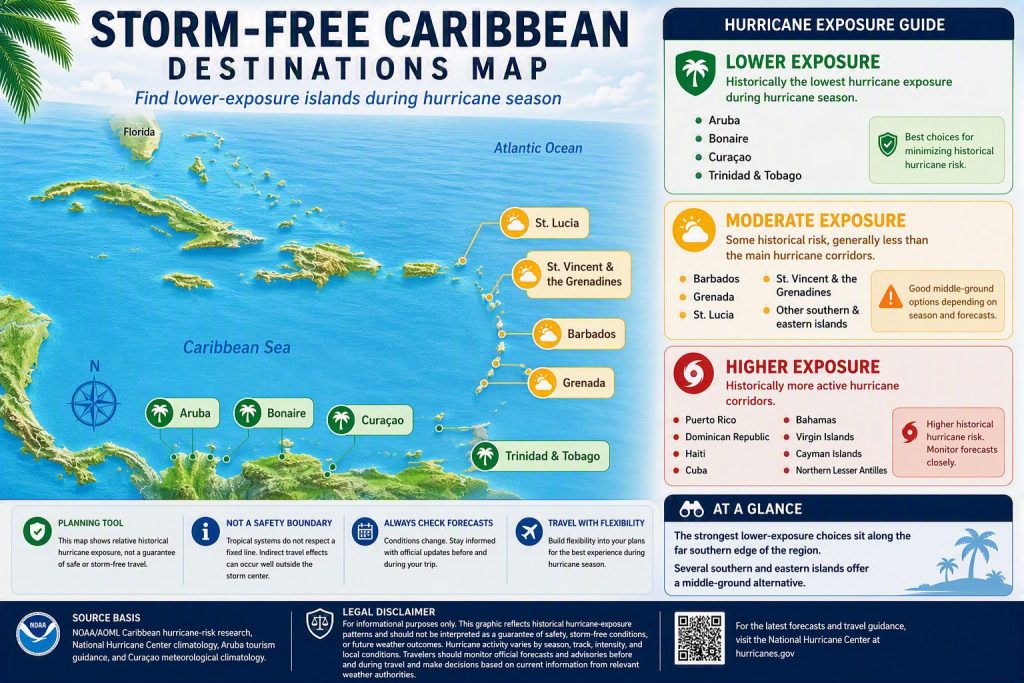
The map belongs here because the regional pattern is easier to understand visually before the island-by-island comparisons begin.
The ABC Islands Are The Strongest Mainstream Choices
Aruba, Bonaire, and Curaçao form the ABC island group, and all three share the same fundamental hurricane-season advantage: a far-southern location near the coast of South America.
Their similarities end there, however. Each island offers a different resort style, activity mix, and travel personality, so the best choice depends on more than storm exposure.
Aruba: The Easiest All-Around Choice
Aruba is usually the first island travelers encounter when they search for a Caribbean destination outside the main hurricane belt.
Its location gives it a comparatively favorable history of direct hurricane exposure, while the tourism infrastructure makes the island easy to book and understand.
Luxury travelers also get a familiar vacation formula.
Large beachfront resorts, polished pools, broad dining choices, casinos, shopping, and easy beach access make Aruba feel more conventional than some of the quieter southern alternatives.
Peak-season visitors often ask whether September or October is still a good time to go.
Those months remain part of the most active Atlantic period, but Aruba’s geography continues to work in its favor compared with many islands farther north.
Weather can still vary.
Passing systems may change wind, surf, cloud cover, or rainfall without producing a direct hurricane impact.
For travelers who want the strongest blend of lower exposure and traditional resort convenience, Aruba is difficult to beat.
Someone who wants more local texture, less resort concentration, or a quieter atmosphere may prefer one of the neighboring ABC islands instead.
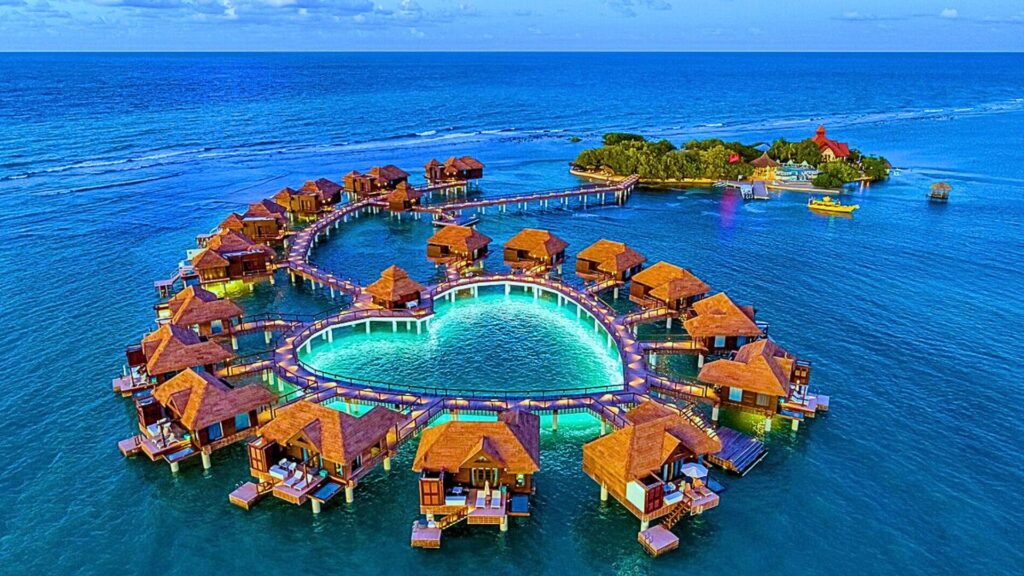
Paradise Is Calling Your Name
Explore Sandals & Beaches deals
Curaçao: Lower Exposure With More City And Culture
Curaçao shares Aruba’s southern advantage but feels different once you arrive.
Willemstad, colorful historic architecture, local dining, coves, beach clubs, and a broader sense of place give the island a more layered personality.
That difference matters for travelers who do not want hurricane risk to be the only reason they choose a destination.
Curaçao can satisfy the weather-risk goal while also offering enough culture and exploration to keep a longer stay interesting.
Historically, direct tropical cyclone impacts on the Dutch Leeward islands have been relatively uncommon compared with islands farther north.
Nearby systems can still create rough water, heavy showers, or temporary changes in marine activities.
Couples often find Curaçao especially attractive because it sits between two travel styles.
You can book a refined beachfront resort, then leave the property for restaurants, architecture, snorkeling coves, and a more active island experience.
If Aruba feels too resort-driven, Curaçao is the strongest alternative with a similarly favorable geographic position.
Bonaire: Best For Diving, Snorkeling, And A Quieter Trip
Bonaire is the least conventional of the ABC trio for travelers expecting large luxury resorts and busy entertainment districts.
What it offers instead is exceptional water access, diving, snorkeling, smaller upscale properties, and a quieter overall rhythm.
That profile makes Bonaire particularly appealing to experienced Caribbean travelers.
Someone who wants a beautiful room, easy access to the sea, and fewer crowds may value the island more than someone looking for nightlife or a broad resort scene.
Hurricane-season geography remains one of its advantages.
Bonaire occupies the same far-southern region as Aruba and Curaçao, so it belongs in the strongest lower-exposure tier.
Travel logistics deserve a little more thought.
Flight options, resort scale, and the island’s quieter character can make it less convenient for travelers who want the simplest possible package.
When the trip is built around diving or a low-key couples escape, Bonaire can be the most satisfying ABC choice even though Aruba receives more mainstream attention.
Trinidad and Tobago: Far South, But a Different Kind of Caribbean Vacation
Trinidad and Tobago deserve inclusion because their southern location gives them a comparatively favorable hurricane profile.
From a purely geographic perspective, they belong in the same broad risk-avoidance conversation as the ABC islands.
Vacation style creates the main distinction.
Trinidad is not primarily a classic luxury beach-resort destination, while Tobago fits that expectation more naturally with beaches, smaller resorts, and a more leisure-oriented feel.
For travelers who care most about minimizing historical storm exposure, Tobago may be especially interesting.
Anyone expecting the extensive all-inclusive infrastructure of Jamaica or the Dominican Republic may find the experience more limited.
That tradeoff can be worthwhile.
A smaller-scale destination may provide the relaxed, scenic trip you want while keeping you farther south than many famous resort islands.
It is also worth separating direct hurricane risk from rainfall or local weather.
Southern location reduces exposure to many hurricane tracks, but it does not guarantee that every day of a peak-season trip will be sunny.
Barbados: A Strong Compromise, Not an ABC Equivalent
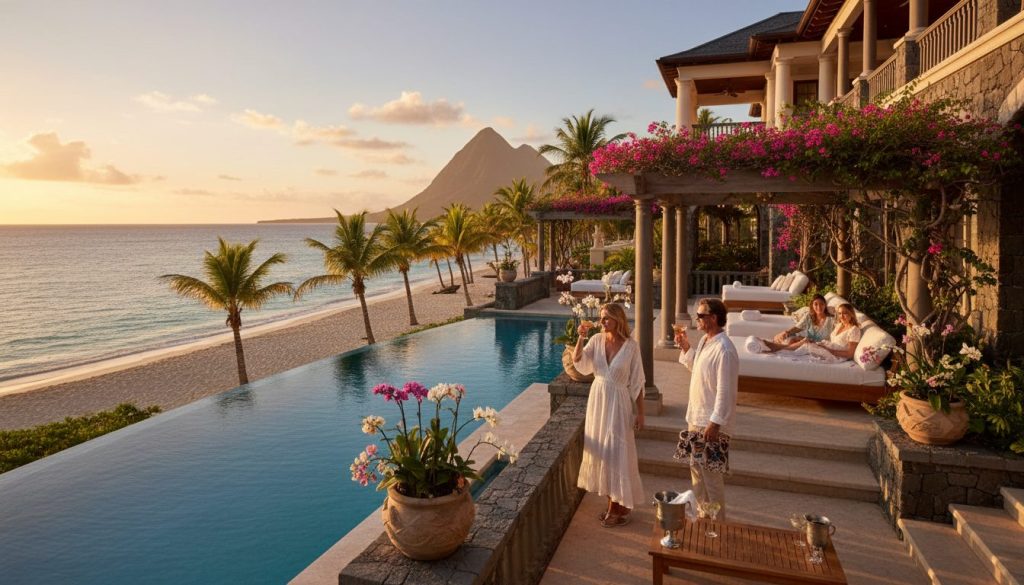
Barbados often appears on lists of hurricane-season alternatives because it lies farther south and east than many of the Caribbean’s more exposed destinations.
That geographic position can make it a sensible compromise for travelers who want a polished resort island without defaulting to Aruba or Curaçao.
Still, Barbados should not be grouped casually with the ABC islands.
Historical exposure is higher, and powerful tropical systems can affect the island or pass close enough to disrupt travel.
What Barbados offers is balance.
Excellent resorts, strong dining, familiar tourism infrastructure, direct air access from major markets, and a recognizable luxury product can outweigh the additional storm exposure for many travelers.
A couple deciding between Aruba and Barbados is therefore making a real tradeoff.
Aruba generally wins on historical hurricane exposure, while Barbados may win on the specific resort, dining scene, beaches, or overall island experience they prefer.
For some travelers, that is a reasonable exchange.
The important part is making it knowingly rather than assuming both islands carry the same weather profile.
Escape the Chaos. Upgrade to Paradise.
See today’s exclusive offers
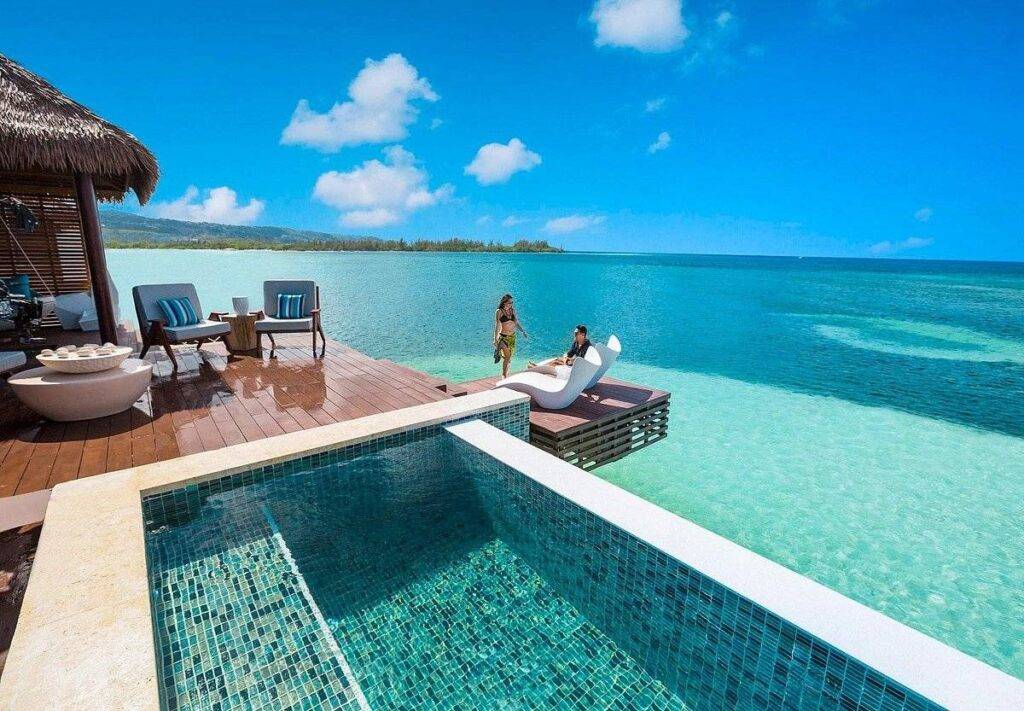
Grenada: A Southern Option With More Exposure Than The ABC Islands
Grenada sits far enough south to deserve consideration, especially for travelers attracted to lush scenery, upscale resorts, and a quieter Caribbean feel.
Its position can look reassuring on a map, but latitude alone does not make an island close to hurricane-free.
History provides the necessary caution.
Grenada has experienced destructive hurricanes, which is why it belongs in a different category from Aruba, Bonaire, and Curaçao.
That does not make a late-summer trip unreasonable.
Travelers who love Grenada’s resorts, mountains, beaches, and romantic atmosphere may decide that the destination is worth the added uncertainty.
Booking flexibility becomes more important in that scenario. Refundable hotel terms, changeable flights, and well-understood resort policies can make the difference between manageable risk and an expensive problem.
If the only goal is minimizing hurricane exposure, the ABC islands remain stronger.
When destination character matters almost as much as weather, Grenada becomes a more competitive choice.
St. Lucia: Choose It For The Experience, Not Because It Is “Storm-Free”
St. Lucia enters hurricane-season conversations because it sits south of many northern Caribbean destinations and offers one of the region’s strongest luxury products.
The Pitons, dramatic terrain, private-pool suites, couples resorts, and honeymoon appeal make it difficult to ignore.
Its geographic position does not place it in the same low-exposure category as Aruba or Curaçao.
Tropical systems can affect St. Lucia, and travelers should plan accordingly during the heart of the season.
That distinction is useful rather than discouraging.
A honeymoon couple may still prefer St. Lucia because the scenery and resort experience matter more to them than having the lowest available hurricane exposure.
The decision becomes easier when the booking is flexible.
Strong cancellation rules and appropriate trip protection can let travelers choose the destination they actually want without pretending the weather risk is lower than it is.
St. Lucia is therefore a good example of how this guide should be used.
Choose the island for its experience, then use hurricane exposure to determine how much protection and flexibility the booking deserves.
Which Destination Is Best If Hurricane Avoidance Is Your Top Priority?
Travelers who want the simplest answer can use a two-tier shortlist.
| Priority | Best Starting Points | Why |
|---|---|---|
| Lowest practical historical exposure | Aruba, Bonaire, Curaçao, Trinidad and Tobago | Far-southern locations avoid many common hurricane tracks |
| Lower-exposure compromise with broader resort appeal | Barbados, Grenada, St. Lucia | More exposure than the ABC islands, but still worth considering when the destination itself is a priority |
This table is intentionally simple.
It does not mean every island in one tier has identical risk, and it does not mean the second tier is “safe” in the same way travelers sometimes use that word.
Your vacation style should break the tie.
Aruba suits travelers who want straightforward resort convenience, Curaçao works well for culture and dining, Bonaire excels for diving, Tobago offers a quieter southern option, Barbados provides polished island variety, Grenada leans romantic and lush, and St. Lucia delivers dramatic scenery.
Direct Hurricane Risk and Trip-Disruption Risk Are Not the Same
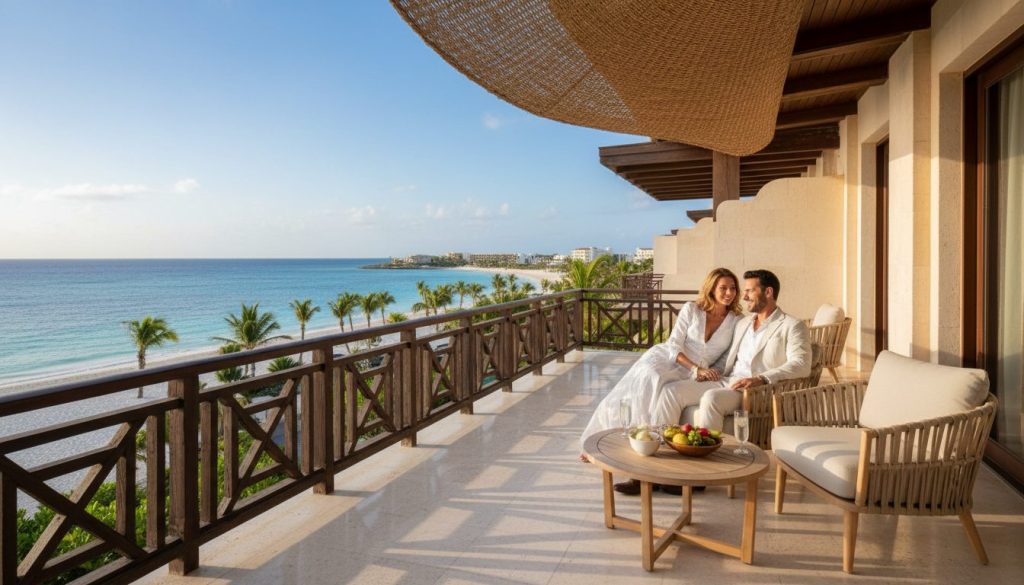
Many travelers focus only on whether a hurricane will hit the island.
That question is understandable, but it is too narrow for real-world vacation planning.
Flights may be canceled because an aircraft or crew is coming from somewhere affected by a storm.
Connecting airports in Florida, Puerto Rico, or another Caribbean hub can create problems even when your resort is under blue skies.
Marine conditions can also deteriorate without a direct landfall.
Snorkeling trips, sailing excursions, beach service, ferries, and dive operations may be suspended because of swell or wind.
Resorts sometimes adjust operations before the weather becomes severe.
Outdoor restaurants may close, furniture may be secured, and activities can be reduced while management watches the forecast.
Those possibilities explain why an island with low direct hurricane exposure can still have a disrupted vacation.
Geography reduces one risk; flexibility manages another.
How The Best Choice Changes By Month
A lower-exposure island is useful throughout hurricane season, but the value of that advantage becomes greater as the Atlantic moves toward its climatological peak.
June And July
Early-season travelers generally face less overall Atlantic activity than they would later in the summer.
Choosing Aruba or Curaçao can lower exposure further, but many travelers may reasonably consider a much wider range of Caribbean destinations during these months.
The decision often comes down to price and weather preferences.
Humidity, rainfall patterns, sea conditions, and resort promotions can matter as much as hurricane history.
Find the Escape You’ve Been Craving.
Reveal limited‑time Caribbean deals
August
Activity usually becomes more established during August, and tropical development expands farther across the Atlantic.
Risk-aware travelers begin to gain more from choosing a lower-exposure island.
Aruba, Bonaire, and Curaçao become especially compelling for travelers who want to keep a Caribbean trip on the calendar while reducing one major source of uncertainty.
September
September is the month when the southern-island strategy becomes most valuable.
The Atlantic typically reaches its climatological peak around this part of the season, and long-track storms can form across a large portion of the tropical basin.
Travelers who want the Caribbean but strongly dislike weather uncertainty often find Aruba or Curaçao easier to justify than Puerto Rico, the Virgin Islands, or the northern Lesser Antilles during this window.
Even then, flexibility remains worthwhile.
A distant storm can still alter flights or marine conditions.
October
October is sometimes misunderstood as “after hurricane season” because activity begins declining from the September peak.
The official season continues, and the western Caribbean can remain important for tropical development.
Southern choices still make sense.
Travelers comparing Jamaica, the Cayman Islands, Aruba, and Curaçao may place greater weight on the ABC islands during this month.
November
Risk generally continues to ease as the month progresses, although tropical systems remain possible until the official season ends on November 30.
The destination shortlist can expand again for travelers who are comfortable accepting some residual uncertainty.
Late November is therefore very different from mid-September.
Treating both periods as simply “hurricane season” hides useful nuance.
Should You Avoid The Caribbean Entirely During Peak Hurricane Season?
Not necessarily.
Avoiding the region may be the right decision if a disrupted trip would create serious financial, work, wedding, or family consequences.
Someone planning a once-in-a-lifetime event with no schedule flexibility may reasonably choose a different season.
Many leisure travelers have more room to maneuver.
A refundable resort stay in Aruba, flexible airfare, and appropriate insurance can create a very different risk profile from a nonrefundable villa on a more exposed island.
Your own tolerance matters as much as climatology.
Some people can enjoy a September trip while checking the forecast occasionally, whereas others will spend the entire week worrying about every tropical disturbance.
A destination is not a good value if the uncertainty ruins the experience before you leave home.
Choosing winter or spring may be the better luxury decision for travelers who know they dislike weather risk.
What To Look for in a Resort During Hurricane Season
Geography should be the first filter, not the last one.
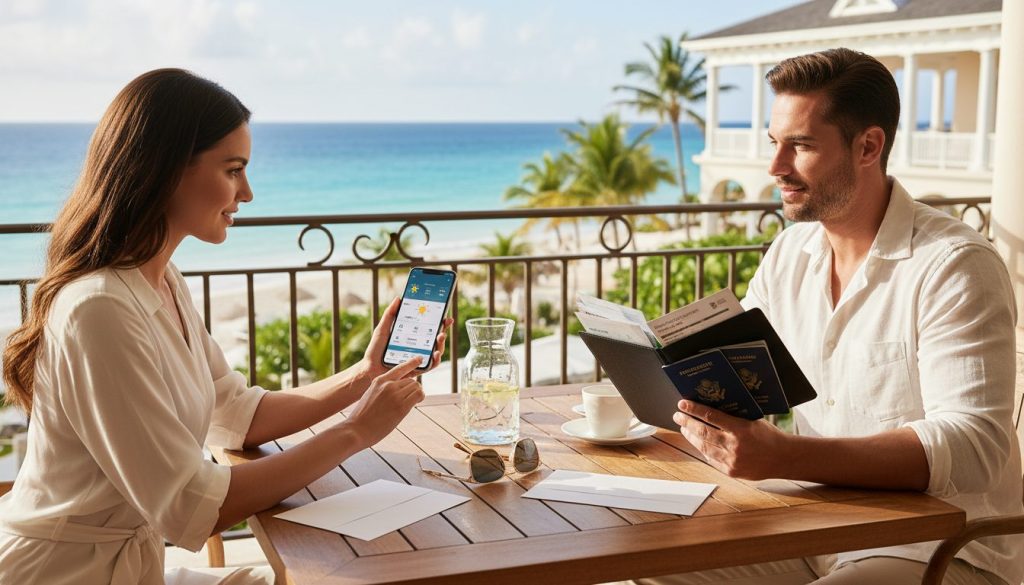
After choosing the island, examine the property’s cancellation and rebooking rules.
Some resorts offer special hurricane guarantees, while others rely on standard cancellation terms until a specific warning, closure, or evacuation condition is met.
Ask what happens if the airport closes.
Find out whether the resort provides a refund, future credit, date change, or no special accommodation at all.
Large luxury properties may have generators, protected interior areas, emergency supplies, and detailed operating procedures.
Smaller boutique resorts can also be well prepared, but travelers should not assume that every property has the same resources.
Transportation matters too.
A resort reached by ferry, small aircraft, or private boat may face disruption sooner than a large hotel located near a major international airport.
How Travel Insurance Fits Into A Lower-Risk Island Strategy
Travel insurance does not make an island safer.
Its role is to reduce the financial consequences when an eligible weather-related problem affects the trip.
High-value vacations deserve closer attention to trip cancellation, trip interruption, travel delay, and missed-connection provisions.
Turn Your Next Getaway into Magic.
Discover your perfect resort match
Policy language matters more than marketing shorthand.
Purchase timing can also be important.
Once a tropical system becomes a known event, buying coverage afterward generally does not create protection for a problem that was already foreseeable.
Travelers comparing options through services such as VisitorsCoverage or Insubuy can review different plans, while EKTA and other providers may also fit certain itineraries.
The right choice depends on the trip cost, cancellation exposure, medical needs, and the specific covered reasons in the policy.
Insurance is most useful when it complements flexible planning.
It should not be used as an excuse to ignore an inflexible resort contract or a complicated flight itinerary.
Which Island Fits Different Types Of Luxury Travelers?
The best lower-exposure destination changes depending on what you want from the vacation.
For The Traveler Who Wants The Easiest Answer
Choose Aruba.
The island combines lower historical hurricane exposure with extensive resort inventory, straightforward beach access, familiar dining, and easy vacation planning.
For Couples Who Want More Character
Curaçao usually makes the stronger case.
Its historic city, dining, coves, and varied neighborhoods add depth beyond the resort.
For Divers And Snorkelers
Bonaire deserves the first look.
The island’s water-focused identity can outweigh its smaller resort scene for travelers who plan to spend much of the trip in or near the sea.
For A Quiet Southern Escape
Tobago can be appealing.
Its southern position supports the risk-avoidance goal while the smaller-scale atmosphere offers something different from a large resort corridor.
For Travelers Who Want A Broader Luxury Island Experience
Barbados offers a strong mix of resorts, restaurants, beaches, and accessibility.
The tradeoff is greater hurricane exposure than the ABC islands.
For A Lush Romantic Trip
Grenada fits travelers who care about scenery, intimacy, and upscale resorts but are comfortable accepting more weather uncertainty.
For A Honeymoon Built Around Dramatic Scenery
St. Lucia may still be the winner.
Its hurricane profile is not as favorable as Aruba’s, yet the Pitons and high-end couples resorts can matter more than the statistical advantage of another island.
A Better Booking Strategy For Hurricane-Season Travel
Begin with the island’s historical exposure.
That step helps eliminate destinations that do not match your risk tolerance.
Next, examine the resort contract before paying a large deposit.
A beautiful room is less appealing if the reservation becomes financially painful when a storm disrupts the trip.
Then compare flight flexibility.
Direct routes reduce the number of airports and connections that can be affected by weather elsewhere.
Consider travel protection once you understand what money is actually at risk.
Expensive prepaid villas, premium airfare, and private transfers deserve more attention than a mostly refundable weekend stay.
As departure approaches, switch from climatology to official forecasts.
Long-term patterns help you choose the destination, while real-time information helps you decide what to do about a developing storm.
Practical Takeaways For Storm-Avoiding Caribbean Travelers
- Choose Aruba, Bonaire, or Curaçao first when minimizing direct hurricane exposure is your top priority.
- Add Trinidad and Tobago when far-southern geography matters more than having a conventional large-resort experience.
- Treat Barbados, Grenada, and St. Lucia as lower-exposure alternatives rather than equivalents to the ABC islands.
- Match the island to your vacation style, because the lowest-risk choice is not automatically the best overall trip.
- Separate direct-hit risk from disruption risk, since flights, surf, ferries, and excursions can be affected without a hurricane landfall.
- Give August, September, and October more planning attention than June, July, or late November.
- Read resort hurricane policies before paying a large nonrefundable balance.
- Use flexible flights and appropriate travel protection when the financial consequences of disruption would be significant.
- Rely on historical climatology when choosing where to go, then use official forecasts when a specific system develops.
- Skip peak season entirely if weather uncertainty would undermine the enjoyment of an expensive trip.
Storm avoidance in the Caribbean is not about finding a mythical island where tropical weather cannot happen.
It is about stacking the odds more intelligently.
For most luxury travelers, the ABC islands provide the strongest starting point.
Southern alternatives widen the choices, while Barbados, Grenada, and St. Lucia can make sense when the destination experience is worth accepting additional exposure.
The best decision combines geography, timing, resort quality, financial flexibility, and your personal tolerance for uncertainty.
When those pieces align, hurricane-season travel can feel much more deliberate and much less like a gamble.
FAQ – Which Caribbean Destinations Come Closest to Storm-Free During Hurricane Season?
Which Caribbean Islands Come Closest to Being Storm-Free During Hurricane Season?
Aruba, Bonaire, and Curaçao are the strongest mainstream answers for travelers trying to minimize historical hurricane exposure.
Trinidad and Tobago also belong in the lower-exposure conversation because of their far-southern position.
None of these destinations can guarantee freedom from rain, rough seas, or indirect travel disruption.
Their advantage is a more favorable long-term storm profile than many islands farther north.Is Aruba the Best Caribbean Island for Avoiding Hurricanes?
For many resort travelers, Aruba is the easiest all-around choice. Its southern location combines comparatively low direct hurricane exposure with a large selection of beachfront resorts, restaurants, and familiar vacation amenities.
Curaçao may suit travelers who want more culture and local exploration, while Bonaire can be better for diving and a quieter atmosphere.
The best island therefore depends on whether convenience, character, or water activities matter most after weather risk.Are Curaçao and Bonaire as Good as Aruba During Hurricane Season?
Yes, both share the same broad southern geographic advantage.
Curaçao offers a more varied mix of city life, dining, beaches, and resorts, whereas Bonaire leans heavily toward diving, snorkeling, and smaller-scale stays.
Direct hurricane exposure is historically lower across the ABC region than in many northern Caribbean destinations.
Vacation style usually becomes the deciding factor once travelers narrow the choice to these three islands.Does Trinidad And Tobago Belong in the Same Lower-Risk Group?
From a geographic standpoint, yes.
Geographically, Trinidad and Tobago sit far south and generally avoid many of the hurricane tracks that affect the northern Caribbean.
Vacation style creates the main difference: Trinidad is not primarily a traditional luxury beach-resort destination, while Tobago fits that model more naturally.
A smart comparison should therefore consider both weather exposure and the type of trip you want.Is Barbados A Storm-Free Caribbean Destination?
Not in the same sense as Aruba or Curaçao.
Barbados can offer a more favorable hurricane-season profile than several northern destinations, yet its historical exposure is higher than the ABC islands.
Strong resorts, dining, beaches, and flight access may still make Barbados the better overall choice for some travelers.
The key is to treat it as a compromise rather than a near-zero-risk substitute.Are Grenada and St. Lucia Good Hurricane-Season Alternatives?
They can be excellent choices when the destination experience matters enough to justify additional weather exposure.
Grenada appeals to travelers who want lush scenery and a quieter romantic feel, while St. Lucia stands out for dramatic landscapes and high-end couples resorts.
Neither island belongs in the same low-exposure tier as Aruba, Bonaire, or Curaçao.
Flexible booking terms become more valuable when choosing either destination during August, September, or October.Can a Lower-Exposure Island Still Have a Disrupted Vacation?
Absolutely.
Flights can be delayed, excursions may be canceled, surf can become dangerous, and connecting airports can be affected even when your island never experiences hurricane-force winds.
That is why direct-hit probability tells only part of the story.
Resort flexibility, transportation routing, and travel protection help manage the separate risk of disruption.Does The Month Still Matter If I Choose Aruba or Curaçao?
Yes.
September remains part of the climatological peak even when you choose one of the Caribbean’s lower-exposure islands.
June and July generally offer a broader margin for travelers who want to consider more destinations, while August through October deserve closer monitoring. Lower exposure improves the geographic odds, but seasonal activity still shapes the wider travel environment.Should I Automatically Choose the ABC Islands for a September or October Vacation?
Not automatically. Choose the ABC islands first when minimizing hurricane exposure is more important than every other destination preference.
Barbados, Grenada, St. Lucia, or another island may still be the right choice if its resort, scenery, or overall experience matters more to you.
A flexible booking can make accepting that additional exposure much easier.What Is the Best Booking Strategy for a Caribbean Trip During Hurricane Season?
Start with geography, then examine the financial and logistical consequences of disruption.
Favor refundable or changeable reservations, understand the resort’s hurricane policy, and reduce unnecessary flight connections when possible.
Travel insurance can help protect eligible prepaid costs when the policy fits the trip.
As departure approaches, rely on official forecasts rather than long-range assumptions about what the season will do.