


Don’t Let One Problem Ruin Your Vacation
A few seconds now protects the trip you’ve already invested so much into.
Short Excerpt
- Hurricane exposure varies dramatically across the Caribbean, so choosing the right island can reduce risk even when traveling during the official June-through-November season.
- Aruba, Bonaire, Curaçao, and Trinidad and Tobago sit along the southern edge of the Atlantic hurricane region and generally have lower historical exposure than many islands farther north.
- Puerto Rico, the Virgin Islands, the northern Lesser Antilles, parts of the Bahamas, western Cuba, and the Cayman Islands sit within historically more active hurricane corridors.
Quick Take
- Lowest relative hurricane exposure: Aruba, Bonaire, Curaçao, and Trinidad and Tobago are among the strongest choices for travelers prioritizing lower historical storm exposure.
- Moderate historical exposure: Grenada, St. Vincent and the Grenadines, St. Lucia, Barbados, Jamaica, Turks and Caicos, the southern Bahamas, and portions of Cuba fall into a middle range.
- Higher historical exposure: Puerto Rico, the Virgin Islands, the northern Lesser Antilles, the Dominican Republic, parts of Haiti and the Bahamas, western Cuba, and the Cayman Islands historically see greater hurricane exposure.
- Risk categories describe long-term patterns rather than predicting what will happen during a specific vacation.
- Even at the busiest point of hurricane season, a short Caribbean trip can still have a relatively small chance of experiencing a direct hurricane hit. NOAA uses Puerto Rico in September as an example, estimating roughly a 2% direct-hit chance during a one-week stay in the historical dataset used for that analysis.
Hurricane Risk Changes Dramatically From One Caribbean Island to Another
Caribbean hurricane season is often discussed as though every island faces the same threat from June through November.
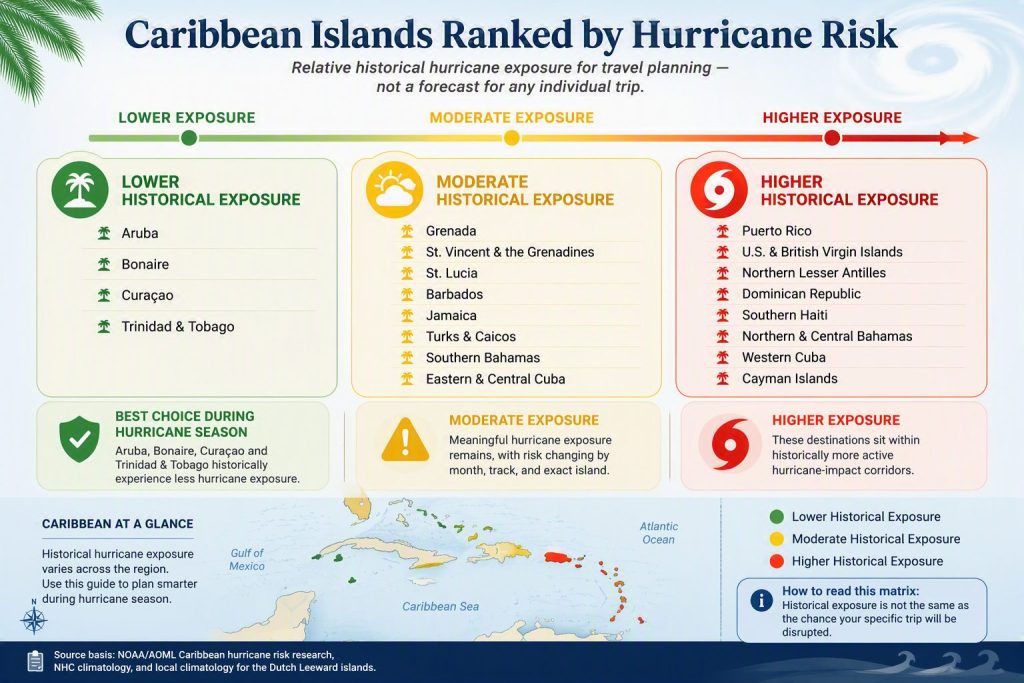
The map tells a very different story.
Some destinations lie directly inside long-established Atlantic hurricane corridors. Others sit so far south that direct hurricane impacts have historically been unusual.
That difference matters when you are choosing between islands for an expensive resort vacation.
A September trip to Aruba does not carry the same historical hurricane exposure as a September trip to the British Virgin Islands.
Likewise, Jamaica, Barbados, Puerto Rico, and the Cayman Islands should not automatically be grouped into one identical risk category simply because all four are Caribbean destinations.

NOAA hurricane research has documented striking regional differences.
One historical analysis classified parts of the northern Caribbean and northern Lesser Antilles above a 10% annual hurricane-impact probability, several central and southern Caribbean areas between 5% and 10%, and locations including Trinidad and Tobago between 1% and 5%.
Those percentages are not forecasts for your vacation.
They describe long-term geographic exposure and are most useful for comparing one region with another.
For luxury travelers, that makes hurricane risk another destination-selection factor alongside beaches, resorts, flight access, dining, privacy, and price.
How This Caribbean Hurricane Risk Ranking Works
The rankings below use relative historical hurricane exposure, not a prediction that one island will or will not experience a hurricane during a particular year.
Three broad tiers make the differences easier to use.
Lower historical exposure includes destinations sitting near the southern fringe of the Atlantic hurricane region, where hurricanes occur less frequently.
Moderate historical exposure covers islands that have meaningful storm history but generally sit below the most exposed Caribbean corridors.
Higher historical exposure identifies areas where hurricanes have historically passed close enough or frequently enough to make storm planning particularly important.
NOAA defines hurricane return periods as the historical frequency at which hurricanes of a given intensity pass within a specified distance of a location.
A shorter return period means hurricanes have historically approached that location more frequently.
No tier means guaranteed safety.
A lower-risk island can still experience rough seas, flooding, flight disruption, or indirect impacts from a nearby tropical cyclone.
Conversely, travelers can spend many hurricane-season vacations in higher-exposure destinations without ever encountering a hurricane.
Caribbean Hurricane Risk Ranking Matrix
The simplest way to compare islands is to look at them side by side before choosing a destination.
| Relative Risk | Caribbean Destinations | Planning Meaning |
|---|---|---|
| Lower Historical Exposure | Aruba, Bonaire, Curaçao, Trinidad and Tobago | Strongest choices when reducing hurricane exposure is a major priority |
| Moderate Historical Exposure | Grenada, St. Vincent and the Grenadines, St. Lucia, Barbados, Jamaica, Turks and Caicos, southern Bahamas, eastern and central Cuba | Hurricanes remain a realistic possibility, especially during peak months |
| Higher Historical Exposure | Puerto Rico, U.S. and British Virgin Islands, northern Lesser Antilles, Dominican Republic, southern Haiti, northern and central Bahamas, western Cuba, Cayman Islands | Greater historical exposure makes booking flexibility and storm planning more important |
The table is best treated as a decision aid rather than a promise.
Conditions during one hurricane season can be very different from another, and storm tracks can vary sharply even within the same island group.
Lower-Risk Caribbean Islands for Hurricane-Season Travel
Aruba
Aruba is one of the clearest choices for travelers who want a Caribbean resort vacation while reducing historical hurricane exposure.
Its location roughly 15 to 18 miles north of Venezuela puts the island well south of the main Atlantic hurricane corridor.
Aruba’s official tourism information describes the island as outside the hurricane belt and notes that hurricanes are extremely rare.
That geography becomes particularly appealing during September and October.
Travelers who would otherwise avoid the Caribbean during peak hurricane season may find Aruba offers a more comfortable risk profile without giving up a traditional resort experience.

The distinction is still lower risk, not zero risk.
Passing hurricanes elsewhere in the Caribbean can affect Aruba indirectly through larger waves, unusual rainfall, wind changes, coastal conditions, or aviation disruption.
For a luxury traveler comparing similarly priced resorts in several Caribbean destinations, Aruba’s historical storm exposure can become a legitimate reason to choose it.
Curaçao
Curaçao shares much of Aruba’s geographic advantage.
The Meteorological Department Curaçao places the Dutch Leeward islands along the southern edge of the Atlantic hurricane region and describes direct impacts as relatively rare compared with islands farther north.
Its historical record shows more than three dozen tropical cyclones passing within 100 nautical miles of Curaçao from 1605 through 2024, while no tropical storm or hurricane in that record made direct landfall on the island.
That does not mean tropical weather should be ignored.
Nearby systems can still produce heavy rain, large waves, unusual winds, excursion disruptions, or temporary changes in resort operations.
Curaçao’s advantage is comparative.
When the alternative is an island sitting directly in a frequently traveled Atlantic storm corridor, its southern location can meaningfully lower historical exposure.

Paradise Is Calling Your Name
Explore Sandals & Beaches deals
Bonaire
Bonaire completes the ABC island group and occupies the same far-southern Caribbean region.
Its location makes it attractive for the same reason travelers consider Aruba and Curaçao during hurricane season: it sits well south of many classic Atlantic hurricane tracks.
Bonaire also appeals to a different type of luxury traveler.
Rather than large concentrations of traditional beach resorts, the island is especially associated with diving, smaller upscale properties, and a quieter vacation style.
Someone choosing primarily on hurricane exposure might consider all three ABC islands together, then make the final decision based on resort style and activities.
Trinidad and Tobago
Trinidad and Tobago sit even farther south than most traditional Caribbean resort islands.
NOAA research places Trinidad and Tobago in the smaller historical hurricane-risk band of roughly 1% to 5% annual impact probability used in that study.
The Trinidad and Tobago Meteorological Service still maintains tropical cyclone forecasting and warning responsibilities because lower exposure does not remove tropical hazards.
From a vacation-planning perspective, the islands can make sense for travelers who prioritize geographic storm exposure over having the most conventional Caribbean resort experience.
Tobago in particular may appeal to visitors seeking beaches and smaller upscale properties.
Moderate-Risk Caribbean Islands

The middle tier requires more nuance because these destinations are neither exceptionally sheltered nor located in the region’s most repeatedly exposed storm corridors.
Grenada
Grenada sits farther north than Trinidad and Tobago but remains near the southern end of the Lesser Antilles.
NOAA historical research places the Lesser Antilles from Grenada through St. Lucia within a moderate hurricane-risk range.
That historical position can make Grenada attractive to travelers who want lush scenery and high-end resorts while accepting more hurricane exposure than they would encounter in the ABC islands.
Major storms are still possible.
Hurricane Ivan’s devastating impact in 2004 remains an important reminder that southern latitude reduces frequency rather than eliminating risk.
St. Vincent and the Grenadines
St. Vincent and the Grenadines sit within the southern Lesser Antilles corridor covered by the same broader moderate-risk pattern.
For luxury travelers, this destination can be appealing because the vacation experience differs considerably from large resort centers.
Private-island properties, sailing, villas, and smaller upscale resorts feature heavily in the region.
That can also complicate storm disruptions.
Guests relying on small airports, ferries, boats, or inter-island transfers should consider transportation resilience as well as the probability of a direct hurricane impact.
St. Lucia
St. Lucia sits at the northern edge of the NOAA study’s Grenada-to-St. Lucia moderate-risk grouping.
Its popularity with honeymooners and luxury travelers makes that distinction important.
A high-end resort overlooking the Pitons can still be a reasonable hurricane-season choice, but September travel here deserves more contingency planning than a comparable stay in Aruba or Curaçao.
Resort policies matter because expensive rooms and private transfers can create substantial prepaid exposure.
Barbados
Barbados is sometimes described too casually as being outside the hurricane belt.
Its easterly and relatively southerly position does give it a different storm profile from Puerto Rico or the northern Leewards, but NOAA’s historical Caribbean analysis places Barbados in the moderate-risk grouping rather than the smallest-risk category.
That distinction is useful.
Barbados can still be attractive during hurricane season, particularly for travelers who prefer its resort infrastructure, dining scene, and direct flights.
It should not be treated as equivalent to Aruba simply because both are relatively far south.
Jamaica
Jamaica occupies a more central location in the Caribbean and falls within NOAA’s moderate historical hurricane-risk grouping.
Its position means storms moving through the Caribbean Sea can approach from the east or southeast before continuing toward Cuba, the Cayman Islands, or Central America.
October deserves special attention.
Even after the September climatological peak, the western Caribbean remains capable of producing tropical systems.
For luxury travelers, Jamaica’s large resort inventory can be an advantage because established properties often have detailed storm procedures.
The resort’s cancellation and rebooking rules still deserve attention before you pay a substantial nonrefundable balance.
Escape the Chaos. Upgrade to Paradise.
See today’s exclusive offers

Turks and Caicos
Turks and Caicos sits near a frequently traveled corridor between Hispaniola, the Bahamas, and the western Atlantic.
NOAA’s historical analysis places the islands in its moderate-risk grouping.
That matters because Turks and Caicos is heavily associated with expensive beachfront resorts and villas.
The financial exposure from a disrupted trip can therefore be substantial even when the probability of a direct hurricane during one particular week remains relatively low.
Peak-season travelers should prioritize flexible bookings and understand resort policies before committing.
Higher-Risk Caribbean Islands
Higher historical exposure does not mean these destinations should be avoided throughout hurricane season.
It means geography gives you less reason to discount hurricane risk when making the booking.
Puerto Rico
Puerto Rico sits directly within one of the Atlantic basin’s historically active hurricane corridors.
NOAA hurricane research places Puerto Rico in its higher-risk grouping, and the island has a long documented history of significant hurricane impacts.
The risk still needs perspective.
NOAA’s Hurricane FAQ uses Puerto Rico during September—the busiest climatological month—as an example.
Its historical analysis estimates about an 8% direct-hit probability for someone staying through the entire month, which drops to roughly 2% for a one-week trip.
That is an important distinction.
Higher relative risk does not mean a hurricane is likely to ruin a one-week vacation.
It means Puerto Rico faces greater historical exposure than lower-risk alternatives.
U.S. and British Virgin Islands
The Virgin Islands sit close to common tracks of tropical systems crossing the Atlantic toward the northeastern Caribbean.
Their geography places them within the region NOAA identifies as having comparatively high hurricane exposure.
August and September deserve particular attention because tropical development can extend far east across the Atlantic by that stage of the season.
Luxury travelers should also consider island logistics.
A hurricane threat can affect ferries, charter boats, small airports, villa services, and inter-island transportation before a direct strike becomes certain.
Northern Lesser Antilles
From Martinique northward through islands such as Guadeloupe, Antigua, St. Kitts, St. Martin, Anguilla, and the Virgin Islands, historical hurricane exposure becomes more pronounced.
NOAA’s Caribbean analysis identifies this northern Lesser Antilles zone among the higher-risk parts of the region.
These islands remain extraordinarily popular for luxury travel.
The ranking is not an argument against visiting them.
It simply means travelers booking in August, September, or early October should have stronger contingency plans than someone staying farther south.
Dominican Republic
The Dominican Republic occupies the eastern two-thirds of Hispaniola and sits within a well-established Atlantic hurricane corridor.
NOAA places the Dominican Republic in its higher historical hurricane-risk grouping.
For travelers, resort location matters too.
Punta Cana, Cap Cana, La Romana, Puerto Plata, and other tourism regions sit on different sides of a large and mountainous country.
A storm’s track can produce very different conditions across the island.
Large Dominican Republic resorts may have extensive hurricane procedures, but those plans do not guarantee uninterrupted flights, beaches, transfers, or excursions.
The Bahamas
The Bahamas cannot be placed neatly into a single hurricane-risk category because the archipelago stretches across a large area.
NOAA’s historical analysis separates the islands geographically.
Northern and central portions fall within its higher-risk grouping, while the southern Bahamas are placed in the moderate tier.
That difference is particularly useful for travelers comparing Nassau, the Out Islands, and destinations farther south.
A generic statement that “the Bahamas are high risk” loses important geographic detail.
The exact island matters.
Find the Escape You’ve Been Craving.
Reveal limited‑time Caribbean deals
Cayman Islands
The Cayman Islands sit in the western Caribbean where systems can strengthen after crossing the central Caribbean or develop closer to the region later in the season.
NOAA places the Caymans within its higher hurricane-risk grouping.
October should not be dismissed simply because September has ended.
Western Caribbean activity can remain meaningful well into the latter half of hurricane season.
For Grand Cayman travelers booking expensive beachfront resorts, knowing the property’s storm policy is especially valuable.
Western Cuba
Cuba’s length produces considerable geographic variation.
Western Cuba falls into NOAA’s higher-risk grouping, while eastern and central portions are categorized more moderately in the historical analysis.
That makes Cuba a good example of why country-level rankings can be misleading.
The island is simply too large for one risk label to describe every destination accurately.
Why A Lower-Risk Island Can Still Have A Disrupted Vacation

Choosing Aruba instead of Puerto Rico can reduce historical hurricane exposure.
It cannot guarantee uninterrupted travel.
A storm hundreds of miles away may alter airline schedules or create large ocean swells.
Resorts can suspend boating, snorkeling, diving, or beach service even when hurricane-force winds never approach the property.
Regional flight networks matter as well.
Your island could experience excellent weather while a connecting airport elsewhere in the Caribbean, Florida, or another hub is dealing with a tropical system.
That is why hurricane risk and trip-disruption risk should be treated separately.
Geography helps reduce one.
Flexible travel arrangements help manage the other.
Should You Automatically Choose A Low-Risk Island In September?
Not always.
Hurricane exposure is only one part of choosing a Caribbean destination.
A traveler who strongly prefers St. Lucia’s mountain scenery, the British Virgin Islands’ sailing, or Puerto Rico’s combination of beaches and culture may reasonably accept greater historical storm exposure.
Someone primarily looking for a luxury beach resort with the smallest practical hurricane concern may reach a different conclusion.
Aruba or Curaçao becomes more compelling in that scenario.
The value of the ranking is not that it produces one correct island.
It helps you understand the tradeoff you are making.
A Better Way To Compare Two Caribbean Islands
Start with the month.
June and July generally carry less Atlantic tropical cyclone activity than September, while the climatological peak occurs around September 10.
Most Atlantic activity is concentrated between mid-August and mid-October.
Next, compare geography.
An ABC island and a northern Lesser Antilles island may offer similar room rates but dramatically different historical hurricane exposure.
Then look at the booking itself.
A refundable $4,000 stay carries a different financial risk from a $15,000 nonrefundable villa reservation.
Finally, evaluate the travel network.
Direct flights, easy airport access, and strong resort infrastructure may make a moderately exposed destination easier to manage than a remote lower-risk island requiring several connections.
Risk is not one number.
It is the combination of storm exposure, financial exposure, transportation exposure, and booking flexibility.
Turn Your Next Getaway into Magic.
Discover your perfect resort match
Travel Insurance Becomes More Important As Trip Cost Rises
Travel insurance does not change an island’s hurricane exposure.
It can change how much money is at risk if severe weather disrupts the trip.
Travelers comparing policies through services such as VisitorsCoverage and Insubuy can examine trip cancellation, interruption, delay, and severe-weather provisions side by side.
EKTA and other travel-protection options may also be worth reviewing depending on the itinerary.
Timing matters.
Once a tropical storm or hurricane becomes a known event, buying coverage afterward generally does not retroactively protect a problem that was already foreseeable.
For an expensive hurricane-season vacation, insurance decisions should be made when the trip is booked rather than when a storm appears on the forecast map.
Practical Takeaways For Choosing A Caribbean Island During Hurricane Season
- Choose Aruba, Bonaire, Curaçao, or Trinidad and Tobago when minimizing historical hurricane exposure is your top priority.
- Treat Barbados, Grenada, St. Lucia, Jamaica, and Turks and Caicos as middle-ground choices rather than storm-free alternatives.
- Give Puerto Rico, the Virgin Islands, the northern Lesser Antilles, the Cayman Islands, and northern or central Bahamas more hurricane-season planning attention.
- Do not assume an entire country has one risk level. Cuba and the Bahamas demonstrate how exposure can change significantly within the same nation or archipelago.
- Separate direct-hit probability from trip disruption. Flights, beaches, excursions, and transfers can be affected without the hurricane center ever reaching your island.
- Match your booking flexibility to the island’s historical exposure. More expensive and less refundable trips deserve stronger contingency planning.
- Use climatology when choosing the destination and official forecasts when the trip approaches.
The biggest mistake is treating the entire Caribbean as one hurricane zone.
It is not.
The southern edge of the region has historically experienced far fewer direct hurricane impacts than several northern and central corridors.
Meanwhile, destinations separated by only a few hundred miles can occupy very different positions in the long-term storm record.
For luxury travelers, that creates options.
You can choose the island first and accept its historical exposure, or start with your hurricane-risk tolerance and use geography to narrow the destination list.
Either approach is more useful than simply avoiding the Caribbean for six months of the year.
FAQ – Which Caribbean Islands Have the Lowest Hurricane Risk?
Which Caribbean Islands Have the Lowest Historical Hurricane Risk?
Aruba, Bonaire, Curaçao, and Trinidad and Tobago stand out for comparatively low historical hurricane exposure.
Their southern Caribbean locations place them away from many of the Atlantic basin’s most frequently traveled hurricane tracks.
Aruba and the Dutch Leeward islands are particularly attractive for travelers who want a traditional Caribbean vacation during September or October.
Lower exposure still cannot guarantee that flights, seas, or local weather will remain unaffected by a nearby storm.Is Aruba Really Outside the Main Hurricane Belt?
Yes. Aruba sits far south near the Venezuelan coast and outside the region commonly described as the main Caribbean hurricane belt.
Hurricanes have historically been extremely rare there, although passing tropical systems can still affect waves, rainfall, and winds.
That makes Aruba one of the stronger luxury-resort choices when reducing hurricane exposure is a major priority.
Travelers should still monitor tropical forecasts as departure approaches.Are Bonaire and Curaçao Also Good Choices During Hurricane Season?
Yes. Bonaire and Curaçao share the southern Caribbean position that makes the ABC islands less exposed than many destinations farther north.
Curaçao’s historical climatology shows tropical systems can pass nearby while direct landfalls remain unusual.
These islands are particularly compelling for travelers who want September or October Caribbean trips without accepting the same historical exposure found in the northern Lesser Antilles.
Diving, smaller luxury properties, and a distinctive drier landscape also differentiate them from many traditional resort islands.Is Barbados a Low-Risk Hurricane Island?
Not quite.
Barbados has some geographic advantages because of its relatively southern and easterly location, but historical hurricane research places it closer to a moderate-risk category than the lower-exposure ABC islands.
A Barbados trip during hurricane season can still be reasonable, especially with flexible reservations.
Travelers should avoid treating Barbados and Aruba as though they have identical hurricane histories.How Risky Is Jamaica During Hurricane Season?
Jamaica falls into a moderate historical hurricane-exposure range.
Its central Caribbean position puts it along routes used by some storms moving west toward Cuba, the Cayman Islands, or Central America.
August through October deserves the greatest planning attention, with October remaining relevant because the western Caribbean can stay active after the September peak.
Jamaica’s large resort inventory can help with preparedness, but cancellation and rebooking terms still vary by property.Why Are Puerto Rico and the Virgin Islands Ranked Higher?
Their location places them near frequently traveled peak-season Atlantic storm corridors.
Long-track systems moving west across the tropical Atlantic can approach the northeastern Caribbean during the heart of hurricane season.
Higher historical exposure does not mean a hurricane is likely during every vacation.
It means travelers choosing these islands in August, September, or early October have more reason to prioritize flexibility and contingency planning.Are All Bahamas Islands Equally Exposed to Hurricanes?
No.
Hurricane exposure changes across the Bahamas because the archipelago stretches over a large geographic area.
Northern and central areas historically fall into a higher-risk grouping, while the southern Bahamas have generally shown somewhat lower exposure.
Travelers should therefore evaluate the specific island rather than applying one hurricane-risk label to the entire country.
Flight routing and resort cancellation terms can also influence the practical risk of a trip.Why Are the Cayman Islands Considered Higher Risk?
The Cayman Islands sit in the western Caribbean, an area that can remain active even after the Atlantic season passes its September climatological peak.
Storms can enter the region from farther east or develop and strengthen within western Caribbean waters.
That geography gives the Caymans greater historical exposure than destinations along the far southern edge of the basin.
October travelers should therefore continue treating hurricane planning seriously.Does Choosing a Lower-Risk Island Guarantee My Vacation Will Not Be Disrupted?
No. A hurricane does not need to strike your island directly to affect your vacation.
Flights can change, ocean conditions can deteriorate, excursions may be canceled, and connecting airports can experience disruptions hundreds of miles from your resort.
Lower-risk islands primarily reduce historical direct hurricane exposure.
Flexible reservations and appropriate travel protection address the separate risk of trip disruption.Should Hurricane Risk Be the Main Factor When Choosing a Caribbean Island?
That depends on your travel dates, budget, and tolerance for uncertainty.
Hurricane exposure deserves more weight during August, September, and October, especially when a trip involves large nonrefundable payments.
Resort quality, flights, beaches, activities, and the ability to change plans should still remain part of the decision.
The strongest choice is usually the island that gives you the vacation you want while keeping weather and financial exposure within a range you are comfortable accepting.