


Don’t Let One Problem Ruin Your Vacation
A few seconds now protects the trip you’ve already invested so much into.
Short Excerpt
- Caribbean hurricane season officially runs from June 1 through November 30, but the six-month window does not carry the same level of tropical activity from beginning to end. (nhc.noaa.gov)
- The most active stretch normally arrives from mid-August through mid-October, with the climatological peak falling around September 10. (nhc.noaa.gov)
- Geography changes the calculation just as much as the calendar because Aruba, Bonaire, and Curaçao historically experience much less direct hurricane exposure than many northern Caribbean destinations. (meteo.cw)
Quick Take
- Hurricane season is better understood as a changing risk curve than as one continuous six-month period of equally dangerous weather.
- June and July usually bring less Atlantic activity, while August, September, and October account for the heart of the season; NOAA notes that 96% of Atlantic major hurricanes occur from August through October. (nhc.noaa.gov)
- Early-season systems favor the western part of the basin, peak-season development expands far into the tropical Atlantic, and late-season formation becomes more concentrated again in the Caribbean and western basin. (nhc.noaa.gov)
- Northern and central Caribbean islands generally have greater historical hurricane exposure than destinations along the far southern edge of the basin, although no Caribbean destination should be treated as hurricane-proof. (aoml.noaa.gov)
- Luxury travelers can reduce disruption by combining destination selection, flexible reservations, resort hurricane policies, insurance, and closer weather monitoring as departure approaches.
Hurricane Season Is a Calendar, Not Six Months of Constant Danger
Seeing the words June 1 through November 30 can make Caribbean hurricane season sound as though the region spends half the year under a continuous threat. That is not how the season behaves.
Tropical activity rises and falls dramatically during those six months.
The official dates define the period when Atlantic tropical cyclones are most likely, but they do not mean a hurricane is equally likely on a June morning in Aruba and a September afternoon in the Virgin Islands.
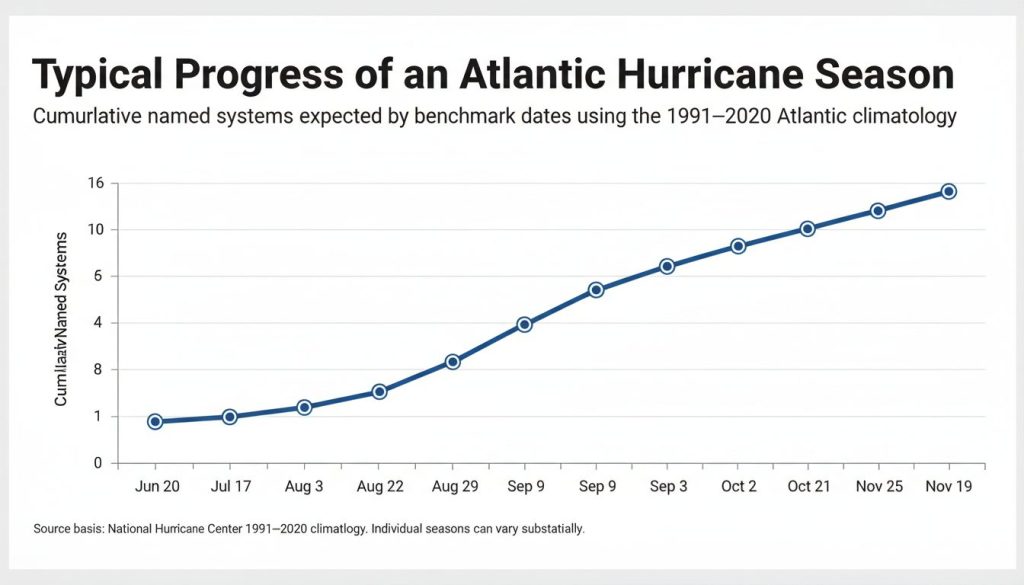
NOAA’s modern 1991–2020 climatology puts an average Atlantic season at about 14 named storms, seven hurricanes, and three major hurricanes.
The first named storm typically develops in mid-to-late June, while the first hurricane usually does not appear until early or mid-August. (nhc.noaa.gov)
Activity accelerates quickly from there. The climatological peak occurs around September 10, and most Atlantic tropical cyclone activity is concentrated between mid-August and mid-October. (nhc.noaa.gov)
That distinction is important for luxury travelers because the phrase hurricane season alone tells you surprisingly little about the risk surrounding a particular vacation.
Your travel month, island, resort flexibility, flight routing, insurance, and willingness to change plans all affect the decision.
A September trip to the northeastern Caribbean deserves a different planning strategy from a late-June stay in Curaçao.
Both technically occur during hurricane season, yet their historical exposure and practical travel considerations are not equivalent.
The goal is not to pretend storms are harmless.
Hurricanes can be destructive, and even a tropical storm that never reaches hurricane strength can disrupt flights, create dangerous surf, produce flooding, or close resort facilities.
Better planning begins by replacing a simple hurricane season versus no hurricane season mindset with a more useful question: Where am I going, when am I traveling, and how much flexibility have I built into the trip?
Caribbean Hurricane Season Timeline Chart
| Period | Typical Atlantic Pattern | What It Means for Travelers |
|---|---|---|
| June | Season begins; activity is usually limited and tends to favor the western Caribbean, Gulf, or nearby western Atlantic | Generally lower seasonal exposure, but travelers should still watch developing systems |
| July | Activity gradually increases and formation areas begin expanding | Risk is building, although the climatological peak remains ahead |
| Early August | Hurricane activity becomes more established | Start treating tropical monitoring as part of normal pre-trip planning |
| Mid-August to Mid-October | Most Atlantic tropical cyclone activity occurs during this period | Highest-alert planning window for most Caribbean vacations |
| Around September 10 | Climatological peak of Atlantic hurricane activity | Historically the most active portion of the season |
| October | Activity remains meaningful while formation increasingly favors the western Caribbean and nearby areas | Late-season Caribbean development becomes especially important |
| November | Overall activity declines but does not disappear | Lower risk than the peak, with continued potential for western Caribbean systems |
| After November 30 | Official Atlantic season ends | Tropical cyclones become unusual, although off-season formation is possible |
The timeline reflects long-term climatology rather than a forecast for any individual year.
NHC data show that storms sometimes form outside the official season, while the overwhelming concentration of activity still falls within the established June-through-November window. (nhc.noaa.gov)
Why August, September, and October Change the Equation
Peak hurricane season does not begin simply because the calendar reaches August.
Several ingredients across the Atlantic become increasingly supportive of tropical development as summer progresses.
Ocean temperatures have had months to warm, atmospheric patterns become more favorable in parts of the tropical Atlantic, and disturbances moving west from Africa have a greater opportunity to organize over enormous stretches of warm water.
By September, tropical storms can form across much of the Atlantic basin.
Long-track systems originating far to the east can cross the tropical Atlantic and approach the Lesser Antilles, Greater Antilles, Bahamas, or surrounding waters days later. (nhc.noaa.gov)
This is the classic period many travelers picture when they hear Caribbean hurricane season.
A system may be identifiable well before reaching the islands, followed by days of model changes, shifting forecast cones, airline decisions, resort preparations, and increasingly specific watches or warnings.
September receives the most attention because it sits near the climatological maximum.
However, treating September as the only month that matters would be a mistake.
August is already part of the main activity period, while October can produce powerful Caribbean hurricanes after the statistical peak has passed.
NOAA’s mariner climatology notes that 96% of Atlantic major hurricanes occur between August and October. (nhc.noaa.gov)
A luxury traveler choosing between July and September is therefore making a meaningful risk tradeoff.
Someone comparing September with October is making a more nuanced decision because both months fall within a historically active portion of the season.
Where Caribbean Storms Form Changes Throughout the Season

One of the most overlooked parts of hurricane planning is that the preferred development zones move as the season progresses.
During June, tropical cyclone formation is more commonly concentrated in the western portion of the Atlantic basin.
The northwestern Caribbean, Gulf region, and waters near the southeastern United States are typical early-season areas. (nhc.noaa.gov)
As July progresses, development gradually expands.

Paradise Is Calling Your Name
Explore Sandals & Beaches deals
August brings a much larger portion of the tropical Atlantic into play.
Disturbances emerging from Africa can begin the long westward journey associated with Cape Verde-type hurricanes, while development remains possible closer to the Caribbean.
September opens almost the entire tropical Atlantic basin to favorable development. Storms may form far east of the islands, near the Lesser Antilles, inside the Caribbean, near the Bahamas, or elsewhere across the broader Atlantic. (nhc.noaa.gov)
October changes the map again. Long-distance eastern Atlantic formation becomes less dominant while the western Caribbean becomes increasingly important.
By late October and November, travelers should pay particular attention to systems developing in the Caribbean itself. A storm does not have to travel all the way from the coast of Africa to become a serious problem.
That seasonal migration explains why an island’s relative exposure can change during the year.
A location that sits away from one common storm corridor may be more vulnerable when formation zones shift later in the season.
Caribbean Hurricane Risk Is Not Equal From Island to Island

Putting every Caribbean island into a single hurricane-risk category makes trip planning unnecessarily crude.
Historical storm tracks show substantial geographic differences across the region.
NOAA research has documented considerably greater hurricane exposure in areas including parts of the northern Lesser Antilles, Puerto Rico, Hispaniola, the Bahamas, western Cuba, and the Cayman Islands than along portions of the far southern Caribbean. (aoml.noaa.gov)
That does not create a simple dividing line between “safe” islands and “dangerous” islands.
Tropical systems change direction, expand in size, intensify rapidly, weaken unexpectedly, and affect destinations far from their centers.
Still, geography provides useful context.
Aruba, Bonaire, and Curaçao
The ABC islands occupy one of the most favorable hurricane-season positions among major Caribbean vacation destinations.
Aruba, Bonaire, and Curaçao sit along the southern fringe of the Atlantic hurricane region near the coast of South America.
Curaçao’s meteorological department describes direct impacts there as relatively rare compared with islands farther north, while Aruba’s government likewise notes that the island lies outside the area most frequently affected by hurricanes. (meteo.cw)
That makes the ABC islands particularly interesting for travelers who want a Caribbean vacation during September or October but would prefer to reduce their historical exposure.
Lower risk does not mean zero risk. Nearby tropical systems can generate high surf, unusual rainfall, wind, marine restrictions, excursion cancellations, and air-travel complications even without a direct hurricane landfall.
The more useful description is lower historical hurricane exposure, not hurricane-proof.
Escape the Chaos. Upgrade to Paradise.
See today’s exclusive offers

Puerto Rico, the Virgin Islands, and the Northern Lesser Antilles
These islands sit much closer to common peak-season storm corridors.
Long-track hurricanes traveling westward across the tropical Atlantic can approach the Lesser Antilles before continuing toward Puerto Rico, Hispaniola, the Bahamas, or turning northward.
August and September deserve particular attention because the eastern Atlantic is much more active by that stage of the season.
For luxury travelers, the decision does not automatically become “do not go.” Instead, flexibility becomes more valuable.
A resort with a clearly documented storm policy, an airline itinerary that can be changed, and travel protection appropriate to the trip can substantially improve your ability to react if forecasts deteriorate.
The Dominican Republic and Haiti
Hispaniola’s position places it in a historically active part of the Caribbean hurricane corridor.
Its mountainous terrain can disrupt a cyclone’s circulation after landfall, yet those same mountains can contribute to serious rainfall and flooding concerns. Wind category alone therefore does not describe the entire hazard.
Luxury resorts in established tourism areas may have extensive hurricane procedures, but resort preparedness cannot guarantee uninterrupted flights, beach conditions, excursions, or transportation.
Anyone traveling during the core August-through-October period should evaluate both the resort and the transportation network surrounding the stay.
Jamaica and the Cayman Islands
Jamaica and the Cayman Islands sit farther west, which changes the storm scenarios travelers need to consider.
Some hurricanes reach the central or western Caribbean after crossing the Lesser Antilles, while other systems organize or intensify after entering Caribbean waters.
October deserves respect in this part of the region because the western Caribbean remains an important formation area even after the September climatological peak has passed. (nhc.noaa.gov)
A late-season trip should therefore not be treated as automatically clear simply because September is over.
Cuba
Cuba stretches across such a large portion of the northern Caribbean that hurricane exposure varies by track and location.
Eastern Cuba can encounter systems emerging from Hispaniola or the central Caribbean, while western Cuba can be affected by storms developing or moving north from the western Caribbean.
Its size also means one part of the island may experience very different conditions from another.
Travelers should evaluate the exact destination rather than treating “Cuba” as one weather point on a map.
The Bahamas and Turks and Caicos
The Bahamas and Turks and Caicos sit in a region frequently crossed by tropical systems moving north or northwest from the Caribbean and tropical Atlantic.
Their location can expose them both to storms approaching from the southeast and to hurricanes beginning their northward turn through the western Atlantic.
Historical climatology consequently gives this part of the region more hurricane exposure than the far southern Caribbean. (aoml.noaa.gov)
Luxury travelers visiting during peak season should pay particular attention to cancellation rules because island aviation and marine transportation can become disrupted before the worst local weather arrives.
Find the Escape You’ve Been Craving.
Reveal limited‑time Caribbean deals
Barbados, Grenada, and the Southern Lesser Antilles
These destinations require more nuance than simply labeling the southern Caribbean “low risk.”
Their more southerly location generally provides different historical exposure from islands farther north, yet tropical cyclones can still move through the southern Lesser Antilles.
Grenada and Barbados should therefore not be placed in exactly the same risk category as Aruba or Curaçao.
Travelers trying to reduce hurricane exposure should look at the specific island rather than choosing any destination carrying a broad “southern Caribbean” label.
A Direct Hurricane Hit Is Not the Only Disruption That Matters
Luxury travel can be affected long before hurricane-force winds reach a resort.
Airlines may begin moving aircraft or allowing itinerary changes as forecasts become more certain.
Regional airports can close, cruise schedules may change, ferries can stop operating, and resorts may suspend water sports or outdoor dining.
Ocean conditions can deteriorate even when the center passes well away from an island.
Heavy rainfall from tropical moisture can also disrupt a vacation without producing anything resembling a direct hurricane strike.
This distinction matters because travelers often ask, “What are the chances my island gets hit?” when the more practical question is, “What are the chances a tropical system meaningfully affects my trip?”
Those probabilities are not the same.
A resort may remain structurally secure while the beach is closed, restaurants operate on reduced schedules, excursions disappear, and your return flight is postponed.
Luxury hurricane planning should therefore consider trip disruption, not merely hurricane landfall.
Why Seasonal Hurricane Forecasts Cannot Tell You Whether Your Resort Will Be Hit
Every spring and again during the season, hurricane outlooks generate headlines about whether the Atlantic is expected to be more or less active than normal.
Those forecasts are useful for understanding the basin as a whole. They are not forecasts for your individual vacation.
NOAA explicitly states that its seasonal outlook does not predict hurricane activity for a particular location.
Storm landfalls depend heavily on shorter-term weather and steering patterns that cannot be reliably determined months ahead. (cpc.ncep.noaa.gov)
That means an active season could leave your chosen island untouched.
A quieter season could still produce one hurricane that crosses your destination.
This is why the number of predicted storms should never become the sole basis for booking or canceling a Caribbean vacation.
Climatology helps you choose the month and destination.
Seasonal forecasts provide broader context. Actual National Hurricane Center forecasts become increasingly important once a specific system develops.
Each tool answers a different question.
How Luxury Resorts Change the Planning Equation
A strong luxury resort cannot move an island out of a hurricane’s path, but resort infrastructure and management can substantially change the guest experience before, during, and after a storm threat.
Established properties in hurricane-prone destinations often maintain emergency procedures covering food, water, generators, communications, guest relocation, staffing, and protected interior areas.
Policies surrounding cancellations and rebooking vary much more widely.
Some resorts provide hurricane guarantees or flexible rebooking when an official warning affects the destination.
Others follow their normal cancellation terms until specific conditions are met.
That difference becomes especially important with expensive villas, suites, destination weddings, and multi-room family reservations.
Before placing a large nonrefundable deposit during peak season, ask what triggers the resort’s storm policy.
Find out whether the policy requires an official hurricane warning, airport closure, mandatory evacuation, or resort closure.
Then determine whether the remedy is a refund, future credit, date change, or something else entirely.
The words hurricane guarantee may sound reassuring, but the actual terms carry far more value than the label.
Travel Insurance Matters More as Your Financial Exposure Grows
A $12,000 Caribbean vacation creates a different hurricane-season decision from a refundable weekend getaway.
Travel insurance can help protect eligible prepaid costs, but travelers should never assume that every hurricane-related cancellation is automatically covered.
Coverage depends on the policy, the reason for cancellation, when the policy was purchased, and whether the storm had already become a known event.
Comparison services such as VisitorsCoverage and Insubuy can make it easier to review different options, while providers including World Nomads and EKTA may also be worth evaluating depending on the traveler and itinerary.
The important step is reading the actual coverage language rather than shopping entirely by price.
Travelers should pay particular attention to trip cancellation, trip interruption, travel delay, missed connections, and coverage relating to severe weather.
A policy cannot prevent a hurricane. Its value is financial flexibility when an otherwise expensive trip becomes impossible or substantially disrupted.
Turn Your Next Getaway into Magic.
Discover your perfect resort match
When Should You Travel if Hurricane Risk Is Your Main Concern?
Travelers who want to minimize tropical cyclone exposure as much as practical will generally find the winter and spring Caribbean season easier to plan.
That does not mean hurricane-season travel is automatically a poor choice.
June can offer an attractive compromise because the official season has begun but climatological activity remains far below the September peak.
July brings somewhat greater tropical potential while still preceding the core August-through-October period.
September usually requires the greatest tolerance for uncertainty, particularly when traveling to destinations along common northern or eastern Caribbean storm corridors.
October remains a serious tropical-weather month even though the statistical peak has passed.
November progressively lowers the overall seasonal risk, yet western Caribbean development remains possible before the season ends.
Destination selection can modify those broad patterns.
Someone committed to a September Caribbean vacation may prefer Aruba or Curaçao over a historically more exposed northern island, while a traveler committed to St. Martin or the Bahamas may decide that June better matches their risk tolerance.
There is no single “best” answer because the decision combines climatology with price, resort preference, schedule flexibility, and the financial consequences of disruption.
How Far Ahead Can You Actually Know Whether a Storm Will Affect Your Trip?
Months before departure, you can understand historical risk.
Weeks beforehand, you can watch the broader tropical Atlantic environment.
Once a disturbance forms, forecast information becomes increasingly useful.
The most meaningful destination-specific decisions usually occur much closer to the trip because hurricane tracks depend on atmospheric steering patterns that evolve over relatively short periods.
NOAA specifically cautions that those landfall details cannot be predicted reliably weeks or months ahead. (cpc.ncep.noaa.gov)
This is why repeatedly checking long-range weather apps 20 days before a Caribbean vacation often creates more confusion than clarity.
Instead, use climatology when booking and official tropical forecasts when the trip approaches.
If a legitimate system begins threatening your destination, pay attention to the National Hurricane Center, the destination’s meteorological authority, your airline, and the resort itself.
A forecast cone is not a guarantee that the center will follow its middle line.
Travelers should consider the broader potential impact area and official warnings rather than fixating on one model run.
The Better Luxury Hurricane-Season Strategy
The strongest hurricane-season plan does not depend on predicting the unpredictable.
Start with the parts you can control.
Choose an island whose historical exposure fits your tolerance for disruption.
Consider whether you are traveling in June, during the September peak, or toward the end of the season.
Evaluate the resort’s hurricane policy before committing significant nonrefundable money.
Use flexible airfare where the added cost makes sense.
Protect large prepaid expenses with suitable travel insurance, particularly when a cancellation would create a meaningful financial loss.
As departure approaches, move from long-term climatology to real-time official forecasting.
That process turns hurricane season from a vague six-month warning into a series of manageable travel decisions.
Practical Takeaways for Caribbean Hurricane-Season Travel
- Do not treat June through November as one uniform risk period. The Atlantic season peaks around September 10, with most tropical activity occurring from mid-August through mid-October. (nhc.noaa.gov)
- Match the island to the month. Geography creates meaningful differences between historically more exposed northern Caribbean destinations and lower-exposure locations such as the ABC islands.
- Remember that October still matters. Western Caribbean formation can remain important after September’s climatological peak. (nhc.noaa.gov)
- Separate seasonal outlooks from destination forecasts. An active or quiet Atlantic forecast cannot tell you months ahead whether a particular resort will experience a hurricane. (cpc.ncep.noaa.gov)
- Ask for the resort’s hurricane policy before paying a large nonrefundable balance. Rebooking rules can matter almost as much as the destination itself.
- Plan for disruption rather than direct landfall alone. Flights, beaches, transfers, excursions, and resort operations can be affected by a system passing well away from the property.
- Use insurance strategically when the trip value justifies it. Review the actual covered reasons and exclusions instead of assuming “hurricane coverage” means every storm-related cancellation qualifies.
- Switch to official forecasts as departure approaches. Historical patterns are useful for booking decisions; developing storms require current National Hurricane Center and local meteorological information.
Hurricane season does introduce additional uncertainty into a Caribbean vacation, especially from August through October.
It does not turn the entire region into a six-month no-go zone.
Luxury travelers have more useful tools than a simple calendar warning: climatology, geography, flexible booking terms, strong resort procedures, appropriate insurance, and increasingly precise forecasts as a trip gets closer.
Once those pieces are separated, the Caribbean hurricane season becomes easier to understand.
The real question is no longer “Is it hurricane season?”
It is “How much hurricane exposure does this island have during my travel dates, and how easily can I change course if the forecast changes?”
FAQ – What Should Luxury Travelers Know About Caribbean Hurricane Season?
Is Caribbean Hurricane Season Equally Risky from June Through November?
No. The official season runs from June 1 through November 30, but tropical activity changes significantly across those months.
June and July generally bring lower climatological activity, while the most active stretch usually falls between mid-August and mid-October.
For luxury travelers, the specific travel month matters far more than the hurricane-season label by itself.When Does Caribbean Hurricane Season Usually Reach Its Peak?
Atlantic hurricane activity typically reaches its climatological peak around September 10.
August, September, and October make up the most important planning window because major hurricanes are concentrated heavily in this part of the season.
A trip during these months is not automatically a bad idea, but flexible reservations and stronger contingency planning become more valuable.
Destination choice also becomes increasingly important as seasonal activity rises.Why Do Caribbean Storm Formation Zones Change During the Season?
Storm formation areas shift because ocean and atmospheric conditions evolve throughout the summer and fall.
Early-season development is more common in the western Caribbean, Gulf region, and nearby western Atlantic.
By August and September, a much larger portion of the tropical Atlantic can support storm formation, including long-track systems moving west from Africa.
During October and November, the western Caribbean becomes increasingly important again.Are Aruba, Bonaire, and Curaçao Lower-Risk Choices During Hurricane Season?
Yes, historically they experience lower direct hurricane exposure than many Caribbean islands farther north.
Aruba, Bonaire, and Curaçao sit along the far southern edge of the Caribbean near South America and outside many common Atlantic hurricane tracks.
That makes the ABC islands especially attractive to travelers considering September or October trips.
Lower historical exposure still does not eliminate the possibility of rough seas, heavy rain, flight disruption, or canceled excursions.How Does Hurricane Risk Differ Between Puerto Rico, the Virgin Islands, and the ABC Islands?
Puerto Rico and the Virgin Islands sit closer to common peak-season Atlantic storm corridors than Aruba, Bonaire, and Curaçao.
Long-track systems crossing the tropical Atlantic can approach the northeastern Caribbean during August and September, increasing the importance of flexible planning.
The ABC islands generally experience fewer direct hurricane impacts because of their more southerly position.
Travelers should still compare the exact destination and month rather than treating either region as completely safe or unsafe.Does October Still Carry Serious Hurricane Risk in Jamaica and the Cayman Islands?
Yes. October comes after the September climatological peak, but the western Caribbean can remain an important area for tropical development. Jamaica and the Cayman Islands may be affected by systems that move into the region or strengthen there later in the season. Travelers should not assume that hurricane risk disappears simply because September has ended.
Can a Hurricane Disrupt a Luxury Resort Without Making a Direct Landfall?
Absolutely.
Flights, ferries, airport operations, beaches, excursions, transfers, restaurants, and water activities can all be affected even when a storm center stays well away from the resort.
Heavy rain and dangerous surf can also disrupt a vacation without hurricane-force winds reaching the property.
Planning for overall trip disruption gives travelers a more realistic picture of risk than focusing only on direct hurricane landfall.What Should Luxury Travelers Check in a Resort’s Hurricane Policy?
Start by identifying exactly what activates the resort’s hurricane terms.
Some properties may require an official warning, airport closure, mandatory evacuation, or resort shutdown before special cancellation or rebooking rules apply.
Travelers should also confirm whether the remedy is a refund, future credit, free date change, or another form of compensation.
These details become especially important for expensive suites, villas, weddings, and multi-room reservations.Does Travel Insurance Automatically Cover Hurricane-Related Caribbean Cancellations?
Not always.
Coverage depends on the policy, the reason for cancellation or interruption, when the coverage was purchased, and whether the storm had already become a known event.
Trip cancellation, trip interruption, travel delay, missed connection, and severe-weather provisions deserve close attention.
VisitorsCoverage, Insubuy, World Nomads, and EKTA are useful options to evaluate when protecting a high-value Caribbean trip.Can Seasonal Hurricane Forecasts Predict Whether a Specific Caribbean Resort Will Be Hit?
No.
Seasonal forecasts estimate overall Atlantic activity but cannot reliably predict months in advance whether a particular island or resort will experience a hurricane.
An active season can leave one destination untouched, while a quieter season can still produce a storm that disrupts a specific trip.
Historical climatology is more useful when choosing when and where to travel, while official storm forecasts become more important once an actual tropical system develops.