


Don’t Let One Problem Ruin Your Vacation
A few seconds now protects the trip you’ve already invested so much into.
Short Excerpt
- Bali can be a beautiful family destination, but parents should not expect it to feel like a Caribbean all-inclusive where the resort handles every part of the day.
- The island works best for families who choose the right base, use private drivers, plan around heat and traffic, protect pool time, and mix kid-friendly resorts or villas with carefully chosen cultural, nature, and dining experiences.
Quick Take
- Bali is family-friendly, but it asks parents to plan differently than they would in the Caribbean.
- Nusa Dua and Sanur are usually the easiest family bases for resort comfort, calmer beach time, kids clubs, and lower-friction days, while Ubud works well for culture, villas, nature, and slower family experiences when parents build in realistic transfer times.
- Seminyak can suit older kids and food-focused families, Canggu works for active families who want cafés and surf energy, Jimbaran offers a quieter coastal rhythm, and Uluwatu is better for families who want views and villas rather than constant convenience.
- Recent Bali family travel guidance continues to frame Nusa Dua as a resort-centered choice, Sanur as a gentler family-friendly coastal base, and Seminyak or Legian as more active areas for families who want dining and action with less transit time.
Bali Family Travel Works Best When Parents Know What Kind Of Easy To Expect
Bali is easy with kids once parents understand what kind of easy the island offers.
It is not always the Caribbean version of easy, where a family checks into a beachfront all-inclusive, sends the kids to a club, walks to the buffet, and lets the resort contain the whole vacation.
Bali can do resort comfort, but the island’s real family appeal is broader than that.
A good Bali family trip might include a private villa with a pool, a Nusa Dua resort with a kids club, a driver-led day to Ubud, a seafood sunset in Jimbaran, an animal park, a water park, a rice terrace walk, and a few slow mornings where nobody leaves the property before lunch.
That variety is the gift.
It is also the planning challenge.
Parents who expect Bali to behave like one contained resort strip can get frustrated by traffic, heat, uneven sidewalks, scooter-heavy roads, long transfers, and excursions that look closer on a map than they feel from the back seat with tired children.
Families who understand those realities can build a trip that feels relaxed, rich, and flexible.
The goal is not to avoid Bali’s texture.
It is to choose the parts of the island that suit your children’s ages, your comfort level, and your patience for movement.
That is where family travel in Bali starts to make sense.
Pick the right region first, then choose the resort, villa, kids club, and excursions around that base.
Visual Aid: Bali Family Suitability Chart
| Family Need | Best Bali Fit | Why It Works | Parent Watch-Out |
|---|---|---|---|
| Easy resort stay with kids club | Nusa Dua | Large resorts, polished service, beach access, pools, and structured family facilities make daily planning easier | Can feel more resort-contained and less connected to everyday Bali |
| Calmer beach town feel | Sanur | Softer pace, walkable beachfront path, family dining, and a gentler coastal rhythm | Less dramatic luxury energy than Uluwatu or Seminyak |
| Private pool and flexible family rhythm | Family villa in Ubud, Sanur, Seminyak, or Canggu | More space, separate bedrooms, kitchen access, private pool, and room for naps or early nights | Pool safety, stairs, road noise, and staff privacy need careful review |
| Culture and nature with children | Ubud | Rice terraces, crafts, temples, animal parks, spa time for parents, and villa-based downtime | Long beach transfers and narrow roads can tire younger kids |
| Dining and activity for older kids | Seminyak or Legian | Restaurants, shopping, beach clubs, hotels, and easy access to Kuta-area attractions | Traffic, busier streets, and nightlife energy may not suit toddlers |
| Surf, cafés, and active family days | Canggu | Surf lessons, cafés, gyms, casual restaurants, and modern villas work for flexible families | Congestion and scooter traffic can feel intense with small kids |
| Sunsets and a softer coastal base | Jimbaran | Seafood dinners, calmer luxury feel, airport convenience, and access toward Uluwatu | Fewer dense walkable attractions than Seminyak |
| Views, villas, and dramatic scenery | Uluwatu | Clifftop resorts, beaches, sunsets, and villa stays can feel special for older kids | Steep access, spread-out roads, and beach conditions need more caution |
| Water parks and classic kid fun | Kuta / South Bali day trip | Waterbom Bali and other attractions can work well as planned family outings | Better as a day trip than a default luxury family base for many parents |
| Low-stress first family trip | Nusa Dua + Ubud or Sanur + Ubud | Combines easy resort or coastal time with culture, greenery, and a fuller Bali experience | Transfers should be scheduled with buffer time and snacks |
Kids Clubs Can Be A Lifesaver, But They Should Not Carry The Whole Trip
Kids clubs can make Bali feel much easier for parents.
That is especially true after a long flight, during the hottest part of the day, or on a resort day when adults want a spa treatment, a quiet lunch, or an hour where nobody is negotiating pool toys.
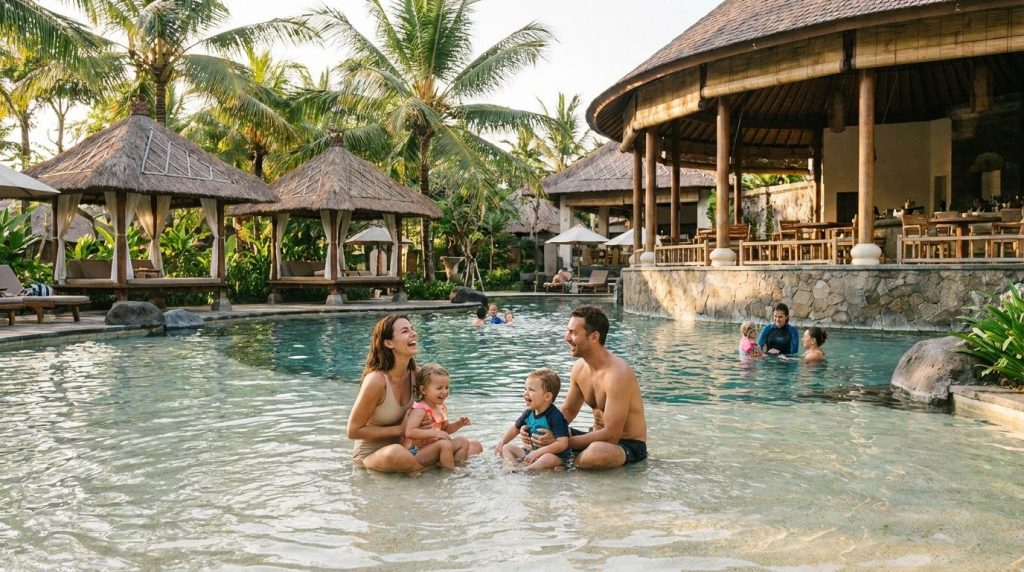
Large family-friendly resorts in Nusa Dua, Sanur, Seminyak, and selected Ubud properties often advertise kids clubs, children’s pools, playgrounds, activities, babysitting options, family rooms, and organized programs.
The quality, however, varies more than parents might expect.
Some kids clubs are polished, supervised, air-conditioned, creative, and genuinely useful.
Others are smaller spaces with limited hours, limited age ranges, or activities that may not hold a child’s attention for long.
Recent 2026 family hotel coverage highlights Bali properties with notable kids clubs and family facilities, including resorts in Nusa Dua and Sanur where children’s clubs, playgrounds, and resort pools are part of the family appeal.
Parents should read the details before booking.
Age minimums matter.
Supervision rules matter.
Opening hours matter.
Extra charges matter.
A kids club that closes during dinner does not solve the evening.
One that requires parents to remain nearby may be useful for play but not for adult downtime.
A club designed for four-to-eight-year-olds may not satisfy a preteen who wants water slides, surf lessons, or more active experiences.
That does not make kids clubs less valuable.
It just means they should be treated as part of the family plan rather than the whole plan.
The best Bali family trips usually combine resort support with pool time, private driver days, child-friendly dining, and a few excursions that fit the kids’ ages.
A kids club gives parents breathing room.
It should not be the only reason a family chooses a resort.

Paradise Is Calling Your Name
Explore Sandals & Beaches deals
Family Villas Give Parents Space That Standard Rooms Often Cannot
Bali’s villa culture can be excellent for families because it solves one of the biggest problems in travel with kids: space.
A family villa can offer separate bedrooms, a living area, a private pool, a kitchen or kitchenette, laundry help, outdoor space, and a quieter rhythm than a standard hotel room.
For parents with babies, toddlers, or children who go to bed early, that difference can shape the entire trip.
Instead of sitting in the dark after bedtime, parents can have dinner on the terrace, swim quietly, talk by the pool, or let the villa staff help arrange breakfast and transport around the family’s schedule.
That is where Bali feels different from a resort-only destination.
The accommodation can become part of the parenting strategy.
Recent Bali family villa guidance describes private villas as especially useful for families who want private chefs, flexible schedules, help with laundry, and space that adapts to the group rather than a hotel’s fixed structure.
Villa choice requires more caution with children than it does for couples.
Pool fencing is not automatic.
Open stairs, polished floors, ponds, outdoor bathrooms, unfenced terraces, low balcony walls, and steep villa layouts can become real issues with toddlers or young kids.
A beautiful design feature may not be child-friendly.
Parents should ask specific questions before booking.
Is the pool fenced or can fencing be arranged?
Are bedrooms connected or separate?
Do any rooms open directly to the pool?
Are there stairs without railings?
Is the villa near a noisy road, nightclub, construction site, or scooter corridor?
Can the staff arrange a baby cot, high chair, pool fence, driver, laundry, groceries, or babysitting?
Those details matter more than a perfect pool photo.
The best family villa is not always the most dramatic one.
It is the property that lets everyone sleep, eat, swim, move, and recover without turning every hour into logistics.
Bali Safety For Families Is Practical, Not Panic-Driven
Bali does not need to be treated like a scary destination for families.
It does need to be treated like a real island with traffic, heat, water safety issues, food hygiene concerns, mosquitoes, monkeys, pools, scooters, and beaches that are not always gentle.
That is a different mindset from fear.
It is awareness.
The most important family safety issue is often transportation.
Parents should be careful with scooters, motorbike taxis, and casual rides when traveling with kids.
Bali roads can be narrow, crowded, wet, and unpredictable, and recent family travel discussions and guides continue to warn parents not to underestimate traffic or transport fatigue with children.
Private drivers are usually the better family choice for airport transfers, day trips, Ubud excursions, Uluwatu sunsets, and region changes.
A good driver gives the family a place to leave bags, snacks, strollers, extra clothes, and tired children between stops.
That kind of comfort matters when the day gets hot or a child hits a wall earlier than expected.
Water safety is another major point.
Not every Bali beach is ideal for swimming, and surf-heavy areas such as parts of Canggu and Uluwatu can be rough for children.
Parents should follow local advice, watch flags where available, ask resort staff which beaches are swimmable, and treat resort pools as the default for easy water play.
Food and hygiene require steady attention too.
Bali tap water is not considered safe to drink, and practical Bali water guidance recommends bottled or properly filtered water, hand hygiene, and care with food choices for sensitive stomachs.
Escape the Chaos. Upgrade to Paradise.
See today’s exclusive offers

That does not mean families need to avoid local food.
It means parents should choose reputable restaurants, keep hand sanitizer nearby, use bottled or filtered water for brushing teeth if needed, and pack basic rehydration support.
The final safety layer is pacing.
A child who is overheated, hungry, tired, and stuck in traffic is more likely to turn a good plan into a hard day.
Bali family safety is not only about avoiding danger.
It is about preventing small discomforts from stacking up.
Excursions Should Be Chosen By Age, Distance, And Energy Level
Bali has excellent family excursions, but parents should be selective.
A temple may be meaningful for adults and boring for a tired four-year-old.
A waterfall may look magical online but require a long drive, slippery steps, and a return ride after everyone is wet and hungry.
A rice terrace can be beautiful for 45 minutes, while a full-day cultural circuit may push kids too far.
This is why family excursions should be chosen by age, distance, and energy level before popularity.
Waterbom Bali is often one of the easiest classic family outings because water parks give kids a clear reward and parents a simple structure.
Family activity guides continue to highlight Waterbom Bali, Bali Safari and Marine Park, Bali Bird Park, rice terrace walks, animal encounters, and selected nature experiences as common family-friendly options.

Bali Safari and Marine Park can work well for families who want animals, shows, and an organized day that feels more predictable than a remote waterfall trip.
Bali Bird Park can be useful for younger children because the experience is visual, contained, and easier to understand.
Rice terraces near Ubud can be a good family experience when treated as a shorter scenic outing rather than a long forced walk.
Visit Bali describes Tegallalang Rice Terraces as a famous stepped landscape about 20 to 25 minutes north of central Ubud, which makes it easier to pair with nearby Ubud experiences than with a far southern base.
Temples can be worthwhile, but parents should prepare children for respectful behavior, clothing expectations, heat, stairs, monkeys, and limited patience for long cultural explanations.
Shorter, better-timed visits usually work better than trying to turn every temple into a major educational event.
Surf lessons can be great for older kids and teens in the right conditions.
Beach clubs can work for families when the venue welcomes children, has shade, food, pools, and clear expectations, but not every beach club has the same family tone.
The best family rule is simple.
Choose one strong outing per day, then protect the pool, nap, snack, and downtime around it.
Bali Is Family-Friendly, But Not In The Same Way As The Caribbean
The Caribbean often makes family travel feel contained.
A family may stay at one resort, eat most meals on property, use the same beach every day, send children to a kids club, and barely think about transportation.
That can be exactly right for parents who want a low-effort vacation.
Bali offers a different kind of family friendliness.
It is more flexible, more cultural, more scenic, and more varied, but it is also less automatic.
Parents may need to arrange drivers, choose regions carefully, think about beach conditions, compare villa layouts, plan around traffic, and build in more rest than the itinerary originally suggests.
The payoff is that Bali can give children more than a resort routine.
They can see rice terraces, watch temple culture respectfully, try tropical fruit, visit animal parks, experience a family villa, learn that not every beach is the same, and feel a destination that has its own rhythm.
For parents, the experience can feel richer too.
A Bali family trip does not need to be only about keeping children entertained.
It can be about showing them a place that feels different while still giving the family enough comfort to enjoy it.
That balance is the real promise of Bali with kids.
Resorts help.
Villas help.
Drivers help.
The island becomes family-friendly when those pieces are chosen with realistic expectations.
Find the Escape You’ve Been Craving.
Reveal limited‑time Caribbean deals
Best Bali Regions For Families
Nusa Dua is the easiest answer for many families because it gives parents the most familiar version of Bali comfort.
Large resorts, kids clubs, pools, breakfast buffets, beach access, and polished service reduce friction.
That makes the region especially useful for first-time families, younger children, multigenerational groups, and parents who want a safer-feeling resort structure.
The tradeoff is that Nusa Dua can feel less connected to the everyday texture of Bali.
That may not matter if the trip’s goal is comfort.
It may matter more if parents want cultural immersion every day.
Sanur is another strong family option because it feels gentler than Seminyak or Canggu.
The beachfront path, calmer dining rhythm, and softer pace make it appealing for families who want a coastal stay without the intensity of Bali’s busier nightlife zones.
Recent family-neighborhood guidance points to Sanur as a practical family base, with walkability, dining, and air-conditioned family-friendly options becoming part of its appeal.

Ubud works well for families who want villas, nature, culture, crafts, rice terraces, animal parks, and a slower inland mood.
It is not a beach base, so parents should choose it for what it does best rather than trying to commute to the coast every day.
Seminyak can work for families with older kids who like restaurants, shopping, pools, beach clubs, and a more active atmosphere.
Parents with toddlers may find the traffic and street conditions more tiring.
Canggu is best for flexible families with older kids or teens who want cafés, surf, casual dining, gyms, and modern Bali energy.
It can feel fun, but it can also feel congested and scooter-heavy.
Jimbaran is a quieter coastal choice that fits families who want sunsets, seafood, airport convenience, and easier access toward Uluwatu.
Uluwatu is beautiful but more spread out, so it suits families who prioritize villas, views, surf, and scenic experiences over walkable convenience.
The best plan for many families is a split stay.
Nusa Dua plus Ubud gives resort comfort and culture.
Sanur plus Ubud creates a gentler coastal-and-inland combination.
Jimbaran plus Ubud can work for families who want beach sunsets, culture, and manageable logistics.
That kind of structure lets Bali feel varied without asking kids to sit in the car every day.
How Resorts Handle Family Comfort
Good Bali resorts understand that parents need more than a beautiful room.
They need breakfast that works for children, pools that feel usable, shaded areas, staff who can help with small emergencies, and a concierge who understands timing.
A resort with a kids club, family pool, connected rooms, babysitting options, and easy dining can turn a complicated family trip into something much calmer.
Parents should look closely at how the resort handles daily family life.
Does breakfast start early enough?
Are there children’s menus?
Is the pool shaded at any point in the day?
Can the resort arrange a car seat, baby cot, high chair, stroller, or babysitter?
Does the kids club require advance booking?
Are there family suites or only separate rooms?
Can the concierge arrange private drivers for day trips?
Those details shape the experience more than the lobby design.
Luxury families should also ask whether the resort is easy to enjoy without leaving every day.
That matters in Bali because transportation can take energy.
A resort with a strong pool, good food, kids activities, and pleasant grounds gives parents more flexibility when the weather changes or the children need a slower day.

Turn Your Next Getaway into Magic.
Discover your perfect resort match
Nusa Dua properties often do this well because the whole region is designed around resort comfort.
Sanur can be easier for families who like walking, casual meals, and a more relaxed beach-town structure.
Ubud resorts and villas can be wonderful when parents want nature and culture, but the property itself needs to be strong enough to support downtime.
The best family resort is not always the one with the longest list of facilities.
It is the one that reduces daily decisions.
Food, Snacks, And Parent-Level Practicalities
Food is one of the easiest parts of Bali with kids when parents choose the right places.
International restaurants, resort buffets, cafés, pizza, pasta, smoothie bowls, rice dishes, fruit, pancakes, and simple grilled proteins are easy to find in major tourist areas.
That makes Bali less difficult than some parents expect.
Still, food hygiene and familiar routines matter.
Young children may not adjust immediately to spice, heat, new textures, or long restaurant meals.
Parents should keep snacks close, choose restaurants with reliable reviews, avoid pushing adventurous food too hard on the first day, and use resort or villa dining when everyone is tired.
For babies and toddlers, specific brands of formula, diapers, wipes, pouches, and medicines may not be identical to what parents use at home.
Many essentials are available in Bali, but families with strict preferences or sensitive children should pack the must-have items rather than assuming every brand will be easy to find.
This is especially true for specialty formula, allergy-safe snacks, medications, and comfort items.
Hydration deserves attention.
Bali heat and humidity can wear children down quickly.
Carry water, use hats, take pool breaks, and treat midday like a reset window rather than prime sightseeing time.
Parents who build the day around breakfast, one outing, lunch, pool time, and an easier evening usually do better than families who try to move nonstop.
That is not underplanning.
It is smart Bali family pacing.
Day-Trip Logistics With Kids
Day trips in Bali need more structure when children are involved.
A couple may tolerate a long ride, a late lunch, a hot temple visit, and a delayed dinner.
Kids often will not.
That does not mean parents should avoid day trips.
It means the itinerary needs fewer stops and better sequencing.
A strong family day begins early, includes a clear main attraction, builds in food, and ends before everyone is worn out.
From Ubud, a family might visit rice terraces, a craft village, Bali Bird Park, or a nearby temple without making the day too scattered.
From Nusa Dua or Sanur, a water park day or easier south Bali outing may work better than trying to force a long waterfall route.
From Jimbaran or Uluwatu, parents can plan beaches, sunset, and one cultural stop, but they should check stairs, surf, shade, and return timing.
Tour platforms such as GetYourGuide, Viator, Klook, Tiqets, WeGoTrip, and Tripadvisor – Experiences can help parents compare pickup points, cancellation terms, group size, and whether an activity is genuinely suitable for the children’s ages.
The pickup point matters as much as the attraction.
A great activity can become a bad family day if the transfer is too long.
Private drivers are usually the better choice for family excursions because they make the day adjustable.
If a child gets tired, the family can skip the next stop.
When lunch takes longer, the route can change.
After rain, the driver may suggest a safer alternative.
That flexibility is one of Bali’s biggest advantages for families who plan well.
Practical Takeaways
Choose Nusa Dua or Sanur when the priority is easy family comfort, calmer beach time, resort pools, and lower-friction days.
Pick Ubud when the family wants culture, villas, rice terraces, animal parks, crafts, and a slower inland mood.
Use family villas for space, privacy, naps, early bedtimes, and flexible meals, but check pool fencing, stairs, noise, and layout carefully.
Treat kids clubs as helpful support, not the whole vacation plan.
Use private drivers for airport transfers, day trips, region changes, and any outing where tired children may need flexibility.
Choose excursions by age, distance, heat, and energy level rather than online popularity.
Protect pool time and downtime because Bali becomes harder with kids when every day is overpacked.
Plan food, hydration, snacks, and hygiene carefully so small discomforts do not derail the trip.
Bali With Kids Works When The Trip Has Room To Breathe
Bali can be wonderful for families because it gives parents more than one kind of vacation.
There is resort ease in Nusa Dua.
Gentler coastal rhythm waits in Sanur.
Ubud brings culture, villas, rice terraces, and a slower pace.
Jimbaran offers sunsets and seafood without the intensity of busier areas.
Seminyak and Canggu can work for families who want dining, cafés, surf, and movement, especially with older kids.
The island’s family appeal comes from variety, but variety needs editing.
Parents do not need to show children every temple, waterfall, beach club, animal park, and rice terrace in one trip.
They need the right base, enough pool time, thoughtful transportation, age-appropriate excursions, and a place to retreat when the heat, traffic, or stimulation becomes too much.
That is why Bali is family-friendly in its own way.
It is not the Caribbean, and that is exactly the point.
A Bali family trip can feel more textured, more cultural, and more memorable when parents stop trying to make it effortless in the same way and start planning for the kind of ease Bali actually offers.
FAQ – Better Bali Family Travel Decisions
Which Bali region creates the easiest family vacation with kids?
Nusa Dua usually delivers the smoothest experience for families because resorts, pools, beach access, and kids clubs sit close together.
Parents can streamline daily plans when fewer transportation decisions are required.
This area supports a lower-stress family rhythm that works especially well for first-time visitors and younger children.Is Bali a good destination for families with young children?
Bali can be an excellent destination for families when expectations match the island’s pace and travel style.
Parents often enjoy better outcomes when they balance sightseeing with pool time, snacks, and rest periods.
The destination rewards thoughtful planning with memorable cultural, nature, and resort experiences.Should families stay in a Bali villa or a family-friendly resort?
A family villa delivers extra space, privacy, flexible meal schedules, and room for early bedtimes.
A resort can simplify logistics through family pools, kids clubs, dining options, and organized services.
The right choice depends on the children’s ages, the family’s routine, and the type of vacation parents want to create.Are Bali kids clubs valuable enough to influence where families stay?
Kids clubs can support parents by providing structured activities and supervised play opportunities.
Many families gain more flexibility when children have engaging options during the hottest part of the day.
Parents should review age requirements, supervision policies, and operating hours before booking.What safety concerns should parents prioritize in Bali?
Transportation, pool safety, hydration, beach conditions, and food hygiene deserve the most attention.
Families can improve comfort and reduce stress by using private drivers and maintaining realistic daily schedules.
Good preparation helps prevent small issues from disrupting an otherwise enjoyable trip.Which Bali attractions tend to work best for children of different ages?
Water parks, animal parks, bird parks, and shorter nature experiences often appeal to a wide range of ages.
Parents can improve each outing by matching activities to attention span, energy level, and travel distance.
Children usually respond better when the day includes a clear highlight and plenty of downtime.How many excursions should families plan during a typical Bali day?
One meaningful excursion per day usually creates a comfortable pace for most families.
This approach helps preserve energy for meals, swimming, relaxation, and spontaneous moments together.
Parents who avoid overscheduling often experience a smoother and more enjoyable vacation.Which Bali areas are best for older kids and teenagers?
Seminyak and Canggu often appeal to older children because they combine dining, shopping, surfing, and activity options.
These areas provide more variety for families seeking a livelier atmosphere.
Parents can maintain flexibility while giving older kids experiences that feel more engaging and independent.What should parents check before booking a family villa in Bali?
Parents should carefully examine pool fencing, stair access, bedroom layouts, balcony safety, and surrounding noise levels.
Practical features often influence daily family comfort more than visual design alone.
A well-matched villa can simplify routines and create a more relaxing stay.Does hurricane season affect Bali family travel plans?
Bali is not generally known as a hurricane destination in the way some other tropical regions are.
Families should still monitor seasonal weather patterns, rainfall, and transportation conditions before traveling.
Flexible planning helps support smoother family experiences when weather conditions change.